
Payment Methods
Payment Methods
PIX - Boletos
Citibank
Carat allows payment of boletos through Citibank.
In this page, the nomenclature "Citibank" will be used to reference the acquirer on Carat Portal.
Carat Portal Interfaces Supported for Integration
The following interfaces for integration with Boleto Citibank are available:
- REST payment
- HTML Payment
- Reprint of boletos
Required credentials
The merchant must obtain with Citibank the credentials listed below, and pass them to Software Express.
| Field | Description | Format | Required |
|---|---|---|---|
codigoBeneficiario | Merchant agreement code at Citibank. | = 20 N | Yes |
codigoAgenciaBeneficiario | Merchant bank agency at Citibank | ≤ 5 N | Yes |
mensagemBeneficiario | Assignor's message. Do not use special character other than “/”, “-“ , “;” or "@". | ≤ 40 N | Yes |
The store may also request the configuration of some parameters of default values with Software Express.
| Field | Description | Format | Required |
|---|---|---|---|
quantidadeDiasCalculoVencimento | Number of days to calculate the standard expiration date. | ≤ 2 N | No |
mensagemReciboPagador | Default message displayed in boleto payment receipt. Note: up to two lines with a maximum of 40 characters. | ≤ 40 AN | No |
mensagemFichaCompensacao | Default message displayed in the boleto instructions. Note: up to two lines with a maximum of 40 characters. | ≤ 40 AN | No |
Citibank payemnt flow
- Successfully generated the boleto.
- The Payment Transaction will remain in 'Processed' status.
- The merchant will receive from Citibank a file with the data of the slips and situation, informing if they were paid.
Payment REST
Boleto payment follows the normal payment flow
Transaction creation
More details in topic Transaction creation
Ex:
{
    "merchant_usn": "7112400307",
    "order_id": "07112400307",
    "amount": "2400",
    "installments": "1",
    "installment_type": "4",
    "authorizer_id": "2601",
    "additional_data": {
        "payer": {
            "name": "Steve",
            "surname": "Harris",
            "address": {
                "zip_code": "01307001",
                "street_number": "35",
                "street_name": "Avenida Paulista",
                "complement": "Ap 10",
                "district": "bela vista",
                "city": "São Paulo",
                "state": "SP",
                "country": "BR"
            },
            "documents": [
                {
                    "type": "CPF",
                    "number": "60861648005"
                }
            ]
        },
        "boleto": {
            "assignor_code": "99999999999999999999",
            "your_number": "1646940087",
            "expiration_date": "20/03/2022",
            "issue_date": "10/03/2022",
            "specie_type": "01",
            "company_identification": "identificacao_empresa",
            "assignor": "XPTO COMPUTADORES DO BRASIL LTDA",
            "assignor_document": {
                "type": "CNPJ",
                "number": "72381189000110"
            },
            "assignor_address": {
                "zip_code": "01307001",
                "street_number": "999",
                "street_name": "Avenida YYZ",
                "complement": "Ap 3000",
                "district": "bela vista",
                "city": "São Paulo",
                "state": "SP",
                "country": "BR"
            },
            "instructions": [
                {
                    "message": "ficha_compensacao msg1"
                },
                {
                    "message": "ficha_compensacao msg2"
                }
            ],
            "receipt_messages": [
                {
                    "message": "recibo msg1"
                },
                {
                    "message": "recibo msg2"
                }
            ]
        }
    }
}
Payment Effectuation
More details in topic Payment effectuation
The effectuation payment response delivers some unique data from the boleto payment
| Field | Description |
|---|---|
| payment.boleto | Boleto's payment exclusive fields |
digitable_line | Digitable line |
url | Boleto's url |
Ex request:
{
    "authorizer_id": "2601"
}
Ex response:
{
    "code": "0",
    "message": "OK. Transaction successful.",
    "payment": {
        "authorizer_message": "OK",
        "status": "PRO",
        "nit": "9901701cc1631cf6fc71a38b0a6e8dba8b8130f2ad1c3109643753223dba312b",
        "order_id": "07112400307",
        "authorizer_id": "2601",
        "acquirer_id": "2601",
        "acquirer_name": "Boleto Citibank",
        "merchant_usn": "7112400307",
        "esitef_usn": "220310093364750",
        "amount": "2400",
        "payment_type": "B",
        "payment_date": "10/03/2022T16:29",
        "boleto": {
            "digitable_line": "47720953885052730207262219741330432820197130661",
            "url": "https://esitef-homologacao.softwareexpress.com.br/e-sitef/reissue.se?nit=9901701cc1631cf6fc71a38b0a6e8dba8b8130f2ad1c3109643753223dba312b"
        }
    }
}
Web Checkout
Transaction creation
More details in topic Transaction creation
Ex:
{
    "merchant_id": "BOLETOCITI",
    "merchant_usn": "7112400307",
    "order_id": "07112400307",
    "amount": "2400",
    "installments": "1",
    "installment_type": "4",
    "authorizer_id": "2601",
    "additional_data": {
        "payer": {
            "name": "Steve",
            "surname": "Harris",
            "address": {
                "zip_code": "01307001",
                "street_number": "35",
                "street_name": "Avenida Paulista",
                "complement": "Ap 10",
                "district": "bela vista",
                "city": "São Paulo",
                "state": "SP",
                "country": "BR"
            },
            "documents": [
                {
                    "type": "CPF",
                    "number": "60861648005"
                }
            ]
        },
        "boleto": {
            "assignor_code": "99999999999999999999",
            "your_number": "1646940087",
            "expiration_date": "17/08/2022",
            "issue_date": "10/03/2022",
            "specie_type": "01",
            "company_identification": "identificacao_empresa",
            "assignor": "XPTO COMPUTADORES DO BRASIL LTDA",
            "assignor_document": {
                "type": "CNPJ",
                "number": "72381189000110"
            },
            "assignor_address": {
                "zip_code": "01307001",
                "street_number": "999",
                "street_name": "Avenida YYZ",
                "complement": "Ap 3000",
                "district": "bela vista",
                "city": "São Paulo",
                "state": "SP",
                "country": "BR"
            },
            "instructions": [
                {
                    "message": "ficha_compensacao msg1"
                },
                {
                    "message": "ficha_compensacao msg2"
                }
            ],
            "receipt_messages": [
                {
                    "message": "recibo msg1"
                },
                {
                    "message": "recibo msg2"
                }
            ]
        }
    }
}
Optional data in Web Checkout
If the buyer's Name, Document and Address data are not sent, a form will be displayed for the buyer to fill out.
Mandatory fields
So that the customer can make a boleto bancário payment, it's necessary that the store submits to Carat Portal the following information:
| Field | Description | Format | Mandatory |
|---|---|---|---|
| additional_data.payer | |||
name | Payer's name. Obs.: concatenation of first name with last name cannot exceed 255 characters. | < 200 AN | Yes |
surname | Payer's surname. Obs.: concatenation of first name with last name cannot exceed 255 characters. | < 200 AN | Yes |
| additional_data.payer.address | |||
street_name | Payer's adress. | < 150 AN | Yes |
street_number | Payer's adress number. | < 20 AN | Yes |
complement | Payer's adress complement. | < 100 AN | No |
zip_code | Payer's zip code. | < 8 N | Yes |
city | Payer's city. | < 50 AN | Não |
state | Payer's state. | = 2 AN | Não |
country | Payer's country AN 3166-1 format. Ex.: BRA | = 3 AN | No |
| additional_data.boleto | |||
assignor_code | Bank relationship number | = 20 N | No |
bank_issuer_code | Bank branch relationship number | < 7 AN | No |
boleto_number | Boleto's identification number. In absent it will be generated | < 14 N | No |
your_number | Number used and controlled by the merchant, to identify the boleto. | < 11 AN | No |
expiration_date | Boleto expiration date in the format dd/mm/aaaa. Note: If not sent, it will be generated based on the authorizer's default configuration | < 10 AN | No |
issue_date | Date of issue of the ticket in the format dd/mm/aaaa. Note: If not sent, it will be generated based on the current date | < 10 AN | No |
specie_type | Code adopted to identify the type of billing document: 01 - Cheque 02 - Trade Duplicate 03 - Trade Duplicate for Indication | = 02 N | Yes |
fine_date | Fine date | = 10 AN | No |
fine_amount | Amount in cents of the penalty for late payment. | < 12 AN | No |
fine_percentage | Percentage of fine to be applied on the value of the boleto, for late payment. | < 12 N | No |
company_identification | Field intended for use by the Beneficiary Company to identify the boleto. | < 25 AN | No |
iof_amount | IOF amount. | < 12 N | No |
assignor | Assignor's Name | < 40 AN | No |
| additional_data.payer.assignor_document | Assignor's document id. Note: If not sent, the merchant configured document will be used | ||
type | Assignor's document type | CPF or CPNJ | No |
number | Assignor's document id | < 14 N | No |
| additional_data.payer.assignor_address | Assignor's address. Note: If not sent, the merchant configured address will be used | ||
street_name | Assignor's address. | < 150 AN | Yes |
street_number | Assignor's address number. | < 20 AN | Yes |
complement | Assignor's address complement. | < 100 AN | No |
zip_code | Assignor's zip code | < 8 N | Yes |
city | Assignor's city | < 50 AN | No |
state | Assignor's state | = 2 AN | No |
| additional_data.boleto.instructions[] | |||
message | Text of observations intended for sending free messages, to be printed in the instructions field of the compensation form Note: If not sent, the default merchant configuration will be used | < 40 N | No |
| additional_data.boleto.receipt_messages[] | |||
message | Text of remarks intended for sending free messages, to be printed on the receipt of the payer's part of the ticket Note: If not sent, the default merchant configuration will be used | < 40 N | No |
| additional_data.boleto.payment | |||
allowed_quantity | Allowed payment quantity | < 2 N | No |
type | Payment type | < 35 AN | Yes |
minimum_amount | Minimum admissible payment amount. | < 12 N | No |
maximum_amount | Maximum admissible amount for payment. | < 12 N | No |
minimum_percentage | Value of the minimum percentage admissible for payment. | < 12 N | No |
maximum_percentage | Value of the maximum percentage admissible for payment. | < 12 N | No |
Reprint of boletos
It is possible to make available to customers the reprint of Citibank boletos.
That functionality is available through the URL:
| Production environment |
|---|
| https:///e-sitef/reissue.se?nit=XXX |
| UAT environment |
| https:///e-sitef-hml/reissue.se?nit=XXX |
The nit used in the original payment transaction, made via Citibank Boleto, must be informed as a GET parameter. Accessing this URL allows viewing the boleto.
If the payment transaction is not in the expected state, it is present an error message.
Attention
The IP address must never be used instead of the domain (or for Certification and Test environment). The IP address can change at any moment without notice, so it is important to always use the domain to access Carat Portal.
PIX - Digital Wallets
A Digital Wallet is an application that securely stores credit/debit/voucher cards in order to facilitate the buyer when performing a payment.
Digital Wallets alone provide only cardholder/card information, and a payment method is required to use this data to actually perform the payment.
The Carat Portal fits into this flow as the Payment Gateway.
This page aims to clarify how a Digital Wallet integrates with Carat Portal services.
Supported Digital Wallets
The Carat Portal supports the following Digital Wallets:
Routing/Acquirers with 3DS authentication support
When adding a card within a Digital Wallet it is possible (when supported) to perform authentication (3DS) during the registration process. When a card is registered in this way, the Digital Wallet will pass on this authentication data to Carat Portal, which in turn will pass on this data to the acquirers.
The routing/acquirers that support 3DS authentication are:
[*] Contact our Carat Portal support team for more information on 3DS authentication support on SiTef.
Integration flow via REST Payment
For further information about REST Payment, access the REST Payment - Overview page.
Below will be presented the basic flow of Digital Wallets integration with Carat Portal using the REST Payment interface.
In this scenario, the integration with the Digital Wallet is splitted between Virtual Store and Carat Portal:
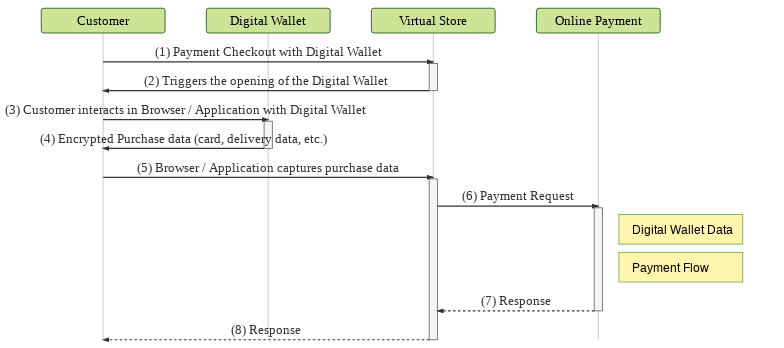
- The Costumer initiates the checkout process inside the Virtual Store and chooses a Digital Wallet as the payment method.
- The Virtual Store, which integrated with the first stage of the Digital Wallet integration (opening the wallet) will show the Digital Wallet interface to the Costumer.
- The Costumer will choose, within the Digital Wallet, the card that will be used to make the payment for the purchase.
- After the Costumer chooses the card, the Digital Wallet will return the encrypted card and purchase data to the Virtual Store application.
- With the encrypted data in hand, the Virtual Store will transfer it to our REST Payment interface through the
card.wallet_transaction_idfield. - The Carat Portal will receive the encrypted data and decrypt it, that is, Carat Portal will have access to the card data to send it to the acquirers to effectively perform the payment.
- The Carat Portal returns to the Virtual Store the transaction result.
- The Virtual Store in turn passes the response from Carat Portal to the Cosutmer.
Integration flow via HTML Payment
For further information about REST Payment, access the HTML Payment - Overview page.
Below will be presented the basic flow of Digital Wallets integration with Carat Portal using the HTML Payment interface.
In this scenario, the integration with the Digital Wallet is carried out entirely by Carat Portal:
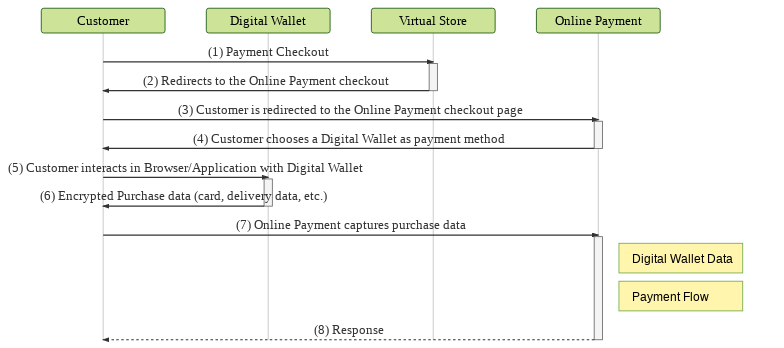
- The Costumer initiates the checkout process inside the Virtual Store
- The Virtual Store initiates a transaction and redirects the Costumer to the Carat Portal checkout page.
- The Costumer, already redirected to the Carat Portal checkout page, verifies the payment options.
- The Costumer chooses a Digital Wallet as payment method.
- The Digital Wallet interface will be displayed for the Costumer who then chooses the card.
- Digital Wallet will return encrypted card/purchase data to Carat Portal.
- The Carat Portal will receive the encrypted card/purchase data and will decrypt it, that is, it will have access to the card data to send it to the acquirers to effectively perform the payment.
- The Carat Portal returns the result of the transaction to the Customer.
Contents of the card.wallet_transaction_id field
card.wallet_transaction_id fieldThe content to be sent in the card.wallet_transaction_id field via the REST Payment interface varies according to the Digital Wallet to be integrated. Consult the specific documentation for more details.
Samsung Pay
How it works
When the payer clicks on the Samsung Pay payment button, the payment methods saved in the Samsung Pay account are displayed. The buyer can quickly select the desired payment method and optionally fill in additional purchase information. After this interaction with Samsung Pay, this same data will be sent / processed by Carat Portal to make the payment flow.
For more information on the payment flow with wallets, see the Overview page.
Required registration data
In cases of integration via the REST API, it will be necessary for the merchant to use the Software Express Service ID with Samsung. To obtain the Service ID of the homologation / production environment contact our support team.
Supported flags
The following card networks available at Samsung Pay (Brazil) are supported by Carat Portal:
| Acronym on Samsung Pay | Flag |
|---|---|
| VI | Visa |
| MC | MasterCard |
REST Payment / Pre-Authorization
In the REST Payment or REST Pre-Authorization, the merchant must perform the first part of the integration with Samsung Pay (all steps of integration until obtaining the Reference ID). please contact Samsung support for more details.
The Reference ID must then be passed on to our REST interfaces.
Send the data to Carat Portal
When the merchant completes the first part of the integration with Samsung Pay, the Reference ID will be obtained.
This data must be passed through the card.wallet_transaction_id field of the interface.
curl -X POST \
  https://esitef-homologacao.softwareexpress.com.br/e-sitef/api/v1/payments/<NIT> \
  --header "Content-Type: application/json" \
  --header "merchant_id: <MERCHANT_ID>" \
  --header "merchant_key: <MERCHANT_KEY>" \
  --data-binary '{
    "authorizer_id": "410",
    "card": {
        "wallet_transaction_id": "ReferenceIdExample"
    }
}'
In the example above, it was defined in the authorizer_id field with the value'410', which corresponds to selecting Samsung Pay as the payment method; and was defined in the wallet_transaction_id field with the value of Samsung Pay's Reference ID. A successful execution of the above command will return a JSON similar to the one below.
{
  "code": "0",
  "message": "OK. Transaction successful.",
  "payment": {
    "authorizer_code": "000",
    "authorizer_message": "Transacao OK",
    "status": "CON",
    "nit": "<NIT>",
    "order_id": "13034649671",
    "customer_receipt": "====PAYER RECEIPT====",
    "merchant_receipt": "====MERCHANT RECEIPT====",
    "authorizer_id": "410",
    "acquirer_id": "1005",
    "acquirer_name": "Redecard",
    "authorizer_date": "28/02/2020T08:57",
    "authorization_number": "132030",
    "merchant_usn": "13034649671",
    "esitef_usn": "170713097340300",
    "sitef_usn": "132030",
    "host_usn": "999132030",
    "payment_date": "13/07/2017T15:52",
    "amount": "1000",
    "payment_type": "C",
    "issuer": "2",
    "authorizer_merchant_id": "<MERCHANT_ID>"
  }
}
HTML Payment/Pre-Authorization
To use Samsung Pay with HTML payment/pre-authorization, contact a member of our support team to perform the necessary configuration. It is possible to determine which flags will be accepted in Samsung Pay for HTML integration.
Important:
Unlike other digital wallets, payment with Samsung Pay will not require CVV on confirmation. It is the responsibility of the merchant to negotiate with the acquirers to perform payments without the requirement of the security code. Otherwise, this parameter will be requested during the transaction flow.However, even if the acquirers allow transactions without the security code (CVV2), there is no guarantee that the issuer (Financial Institution) accepts a transaction with this condition (no security code).
REST Capture of Pre-Authorization and REST Cancellation/via Portal
Samsung Pay does not allow the same Reference ID to be used more than once. Because of this, two-step operations such as Payment/Cancellation, Pre-Authorization/Capture require that the card be stored in Carat Portal. The storage via the HTML interface can be done together with the payment/pre-authorization following the documentation of Payment with card storage or through the REST interface, as described in the chapter below.
REST Card Storage
Card storage is possible using Samsung Pay's Reference ID. Please contact our support team to make the necessary settings to enable this storage.
REST card storage works as if you were to store any card, but with the following precautions:
- Instead of sending the card number, send the
wallet_transaction_idfield with the content of the Reference ID. - The
authorizer_idfield must be '410' (Samsung Pay).
For more details, see here.
Apple Pay
Apple Pay is now available!

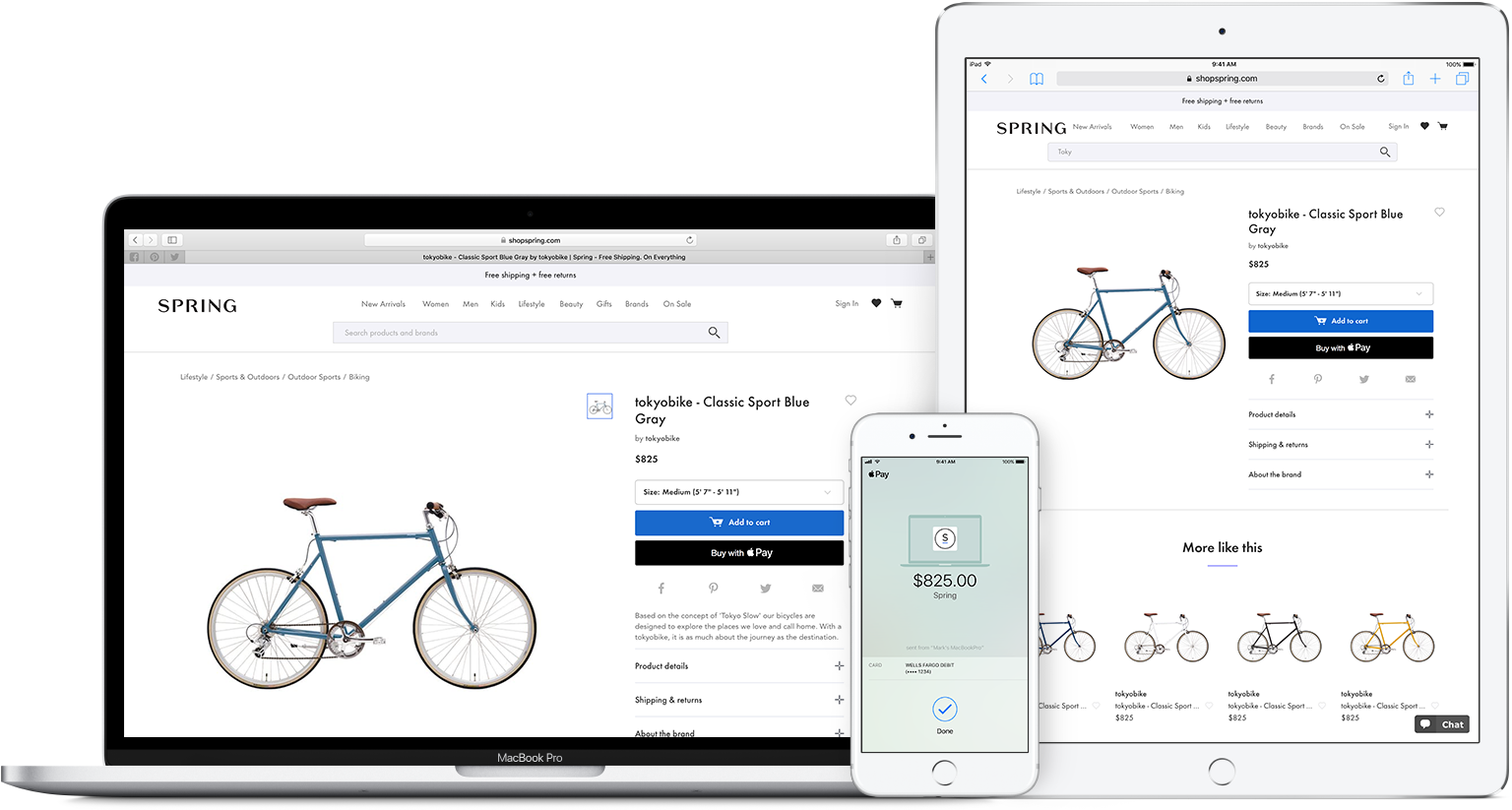
Benefits
- Increase Conversion Rates with Apple Pay.
- Grow your business by making checkout easy with Apple Pay and [PSP].
- Boost sales by offering a fast, simple, and secure checkout experience with Apple Pay.
- Improve Privacy and Security: Every transaction requires authentication with Face ID, Touch ID, or passcode.
Apple Pay boosts conversion rates and user adoption by making buying easier than ever. It’s a simple and secure way for online
shoppers to speed through checkout and for online businesses to increase sales. It's a win for shoppers and a win for businesses.
Introduction
Apple Pay is a wallet available only for iOS devices with a Secure Element - a chip that securely stores payment information. The list of compatible devices can be found here.
Apple Pay offers 2 JavaScript APIs for web integration - the Apple Pay JS API and the Payment Request API. For integration with Carat Portal, was chosen the Apple Pay JS API. Both APIs are natively available in the Safari browser.
How it works
As mentioned in the previous section, due to its availability on compatible devices, the payment button via Apple Pay will only be displayed on compatible devices. Once the buyer is on the payment screen with the available Apple Pay payment method, simply click on the payment button to select the desired card for payment. When the buyer clicks on the Apple Pay button, selects the card and confirms the transaction, interactions must occur between Carat Portal and Apple Pay, to create the payment transaction and confirm the payment. After the last interaction with Apple Pay, the transaction is processed on Carat Portal for payment confirmation.
For more information on the payment flow with wallets, see the Overview page.
Required registration data
The merchant must register their Merchant ID on the Apple system. This registration acts as the store identification at Apple for Carat Portal. It is also necessary to associate this record with the Carat Portal certificate and with a domain, which would be the address of the payment page (where the Apple Pay payment button is made available). For this 2nd step, contact our support team.
Supported payment networks
The following payment networks are available at Apple Pay (Brazil) and supported by Carat Portal: Visa and MasterCard.
Integrate with Apple Pay
To start processing payments with Apple Pay, you need to integrate Apple via the Web. During the integration, you will see that some parameters are required to process Apple Pay via Carat Portal:
- The
merchantIdentifierparameter must be filled in with the Merchant ID of the store in Carat Portal. It is enough to have registered the same in the Apple Pay portal and in the store configuration in Carat Portal that it will be automatically filled out and sent in the requisition to Apple Pay; - The
domainNameparameter must be filled in with the domain of the store's website. Just have the same registered on the Apple Pay portal, associated with the Merchant ID, and it will be validated correctly with Apple Pay.
These parameters are used in the first request for Apple Pay (when the Apple Pay button is clicked), called "startSession", which has the function of creating the payment session, identifying which store the request comes from. The data entered is validated on the Apple server and returns an error when the data entered in the request does not correspond to the data registered with Apple.
Here is an example of a request for startSession:
 curl --location --request POST 'https://apple-pay-gateway-cert.apple.com/paymentservices/startSession' \
--header 'Content-Type: application/json' \
--data-raw '{
    "merchantIdentifier": "merchant.br.com.softwareexpress.teste.e-SiTef",
    "domainName": "esitef-homologacao.softwareexpress.com.br",
    "displayName": "Teste Apple Pay para eSiTef"
}'
The Apple Pay JS API coordinates all calls required for Apple Pay to complete the transaction. After startSession, the latter's response is passed on to completeMerchantValidation. At this time, the Apple Pay payment window has successfully validated the store's credentials and is awaiting confirmation of payment by the user. When the user confirms the payment, using a password or fingerprint, the onpaymentauthorized function is activated, with the payment information encrypted within the event object.
// function that integrates Apple Pay operations with back-end calls
var _handleApplePayEvents = function (appleSession) {
  // store identification validation
  // first function called when Apple Pay button is clicked
  appleSession.onvalidatemerchant = function (event) {
    // call to startSession and then the response is sent to completeMerchantValidation
    _validateApplePaySession(event.validationURL, function (merchantSession) {
      appleSession.completeMerchantValidation(merchantSession);
    });
  };
  };
REST Payment / Pre-Authorization
In the form of Payment or Pre-Authorization, the retailer must perform the first part of the integration with Apple Pay (all the steps described in the previous section to obtain the token). For more details regarding this process of obtaining the token, it is recommended to contact Apple Pay support.
The obtained token must then be passed on to our REST interfaces.
Send the data to Carat Portal
When you complete the first part of the integration with Apple Pay, you will have the token at hand.
This data must be passed through the card.wallet_transaction_id field of the interface.
curl -X POST \
  https://esitef-homologacao.softwareexpress.com.br/e-sitef/api/v1/payments/<NIT> \
  --header "Content-Type: application/json" \
  --header "merchant_id: <MERCHANT_ID>" \
  --header "merchant_key: <MERCHANT_KEY>" \
  --data-binary '{
    "authorizer_id": "421",
    "card": {
        "wallet_transaction_id": "some token from Apple Pay"
    }
}'
In the example above, it was defined in the authorizer_id field with the value 421, which corresponds to selecting Apple Pay as a form of payment and was defined in the wallet_transaction_id field with the value of the Apple Pay token. A successful execution of the above command will return a JSON similar to the one below.
{
  "code": "0",
  "message": "OK. Transaction successful.",
  "payment": {
    "authorizer_code": "000",
    "authorizer_message": "Transacao OK",
    "status": "CON",
    "nit": "<NIT>",
    "order_id": "13034649899",
    "customer_receipt": "====CUPOM COMPRADOR====",
    "merchant_receipt": "====CUPOM ESTABELECIMENTO====",
    "authorizer_id": "421",
    "acquirer_id": "1005",
    "acquirer_name": "Redecard",
    "authorizer_date": "12/03/2021T14:33",
    "authorization_number": "132030",
    "merchant_usn": "13034649671",
    "esitef_usn": "170713097340300",
    "sitef_usn": "132030",
    "host_usn": "999132030",
    "payment_date": "12/03/2021T15:52",
    "amount": "1000",
    "payment_type": "C",
    "issuer": "2",
    "authorizer_merchant_id": "<MERCHANT_ID>"
  }
}
HTML Payment/Pre-Authorization
To use Apple Pay with your HTML payment / pre-authorization, contact a member of our support team to perform the necessary setup. It is possible to determine which flags will be accepted in Apple Pay for HTML integration.
REST Capture of Pre-Authorization and REST Cancellation/via Portal
Apple Pay does not allow the same token to be used more than once. Because of this, two-step operations such as Payment / Cancellation, Pre-Authorization / Capture requires that the payer's card be stored in Carat Portal. The storage through the HTML interface can be carried out together with the payment / pre-authorization, following the Payment documentation with card storage or through the REST interface, as described in the following section.
REST Card Storage
Card storage is possible using Apple Pay's token. Please contact our support team to make the necessary configurations to enable this storage.
The REST card storage works as if you were going to store any card, but with the following precautions:
- Instead of sending the card number, send the
wallet_transaction_idfield with the content of the token. - The
authorizer_idfield must be '421' (Apple Pay).
For more details, see here.
Merchant Key Management
For the correct processing of a transaction by ApplePay, it is necessary to have a public key register on the Apple Server. The public and private keys provided by the Apple Server will serve as the basis for the decript of the payload sent by the Apple JS library. This is the first step in setting up a Merchant to receive ApplePay payments.
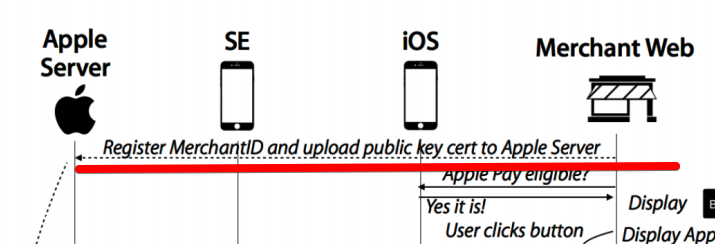
In this guide you can see more details of the registration of keys on the Apple Server.
After registering the keys, it is necessary to contact our support and inform them, so that they can be configured in the store register. Apple requires that it is possible to register two key pairs. Each key has a validity period and the merchant will be in charge of managing the validity and informing the new keys to Software Express support.
Important: Note that there are 2 key pairs - one pair is responsible for decryption and the other pair is responsible for creating a server connection session with Apple.
Mercado Pago
This documentation describes the integration with Mercado Pago payment platform and also explains about the settings that must be made at the Carat Portal environment.
Carat Portal supported Interfaces for integration
It is possible to use the following interfaces for integration with Mercado Pago routing:
Required credentials
The merchant must get at the Carat Portal-Portal the credentials listed below, and pass them on to Software Express or register on the Carat Portal-Portal.
| Parameter | Description | Required |
|---|---|---|
public_key | The application's public key to know, for example, the means of payment and to encrypt card data. | YES |
access_token | Application private key to generate payments. | YES |
Authorizer codes
Below are the codes to be used in this integration:
440: PIX402: other forms of payment with Mercado Pago
Attention: In Mercado Pago's approval environment, it is not possible to simulate an approved PIX transaction. The transaction will be pending.
Mercado Pago specific parameters
HTML payment creation service
Below are the Mercado Pago-specific requisition parameters for the HTML payment creation service:
| Parameter | Description | Size | Required |
|---|---|---|---|
additional_data | Additional transaction data. | ||
application_fee | Mercado Pago commission amount in cents | < 12 N | NO |
binary_mode | Binary approval mode. When set to true, payment can only be approved or denied (not pending). | < 5 AN | NO |
discount_campaign_id | Discount campaign identifier | < 1024 AN | NO |
discount_amount | Discount coupon amount in cents | < 12 N | NO |
acquirer_expiry_date | Payment expiration date in format AAAA-MM-DDTHH:MM:SS | = 19 AN | NO |
acquirer_expiry_date_from | Date from which payment initiation will be active in the format AAAA-MM-DDTHH:MM:SS | = 19 AN | NO |
acquirer_expiry_date_to | Payment initiation expiration date in the format AAAA-MM-DDTHH:MM:SS | = 19 AN | NO |
acquirer_expires | Boolean indicating if payment initiation expires. | < 5 AN | NO |
description | Payment reason or item title | < 1024 AN | NO |
extra_info | Additional Information | < 1024 AN | NO |
max_installments | Maximum installments number | < 2 N | NO |
additional_data.items[] | Shopping cart data. It is required to send at least one item, and the sum of the cart prices must be equal to the total transaction amount (amount field, in the JSON root). | ||
id | Product ID | < 1024 AN | NO |
title | Item name | < 1024 AN | NO |
description | Item Description | < 1024 AN | NO |
picture_url | Item Image URL | < 1024 AN | NO |
category_id | Item category: art, baby, coupon, donation, computing, camera, video_game, television, car_eletronic, automotive, entertainment, fashion, game, home, musical, phone, service, learning, ticket, travel, virtual_good or other | < 1024 AN | NO |
quantity | Item quantity | < 7 N | SIM |
unit_price | Item unit price in cents | < 12 N | SIM |
additional_data.payer | Customer Data | ||
name | Customer's name | < 1024 AN | NO |
surname | Customer's surname | < 1024 AN | NO |
email | Customer's email. | < 1024 AN | NO |
creation_date | Date of account creation in the format DD/MM/AAAA | = 10 AN | NO |
identification_type | Customer identification type | < 1024 AN | NO |
identification_number | Customer identification number | < 1024 AN | NO |
type | Type of identification of the associated payer: guest, customer ou registered | < 10 AN | NO |
additional_data.payer.phones[] | Customer's phone | ||
ddd | Phone area code | < 1024 AN | NO |
number | Customer's phone number | < 1024 AN | NO |
additional_data.payer.address | Customer's address | ||
street_name | Customer's address | < 1024 AN | NO |
street_number | Customer's address number | < 1024 AN | NO |
zip_code | Customer's zip code | < 1024 AN | NO |
additional_data.shipment | Delivery address | ||
mode | Shipping Mode:
| < 1024 AN | NO |
local_pickup | Preference for removing packages in agency (boolean). Just for mode = me2. | < 5 AN | NO |
dimensions | Package size in cm x cm x cm, gr. Just for mode = me2. | < 1024 AN | NO |
default_shipping_method | Choose a standard shipping method at checkout. Just for mode = me2. | < 1024 AN | NO |
cost | Cost of transportation in cents. Just for mode = custom. | < 12 N | NO |
free_shipment | Free shipping preference (boolean). Just for mode = custom. | < 5 AN | NO |
additional_data.shipment.free_methods[] | Offer a free shipping method. Just for mode = me2. | ||
id | Shipping method identifier | < 1024 AN | NO |
additional_data.shipment.address | Delivery address | ||
zip_code | Delivery address zip code | < 1024 AN | NO |
street_number | Delivery address number | < 1024 AN | NO |
street_name | Delivery street name | < 1024 AN | NO |
floor | Delivery floor number | < 1024 AN | NO |
apartment | Delivery apartment number | < 1024 AN | NO |
city | Delivery city | < 1024 AN | NO |
state | Delivery state | < 1024 AN | NO |
additional_data.payment_method.excluded_payment_methods[] | Payment methods to be excluded from the Mercado Pago payment flow | ||
id | Payment method ID to be deleted:
| < 1024 AN | NO |
additional_data.payment_method.excluded_payment_types[] | Payment types to be excluded from the Mercado Pago payment flow. | ||
id | Payment type ID to be deleted: debit_card, credit_card ou ticket. | < 1024 AN | NO |
additional_data.payment_method.ad_tracks[] | Tracks that will be executed during user interaction in the Payment flow. | ||
type | Tipo da track:
| < 1024 AN | NO |
conversion_id | Track conversion ID | < 1024 AN | NO |
conversion_label | Track Conversion Label | < 1024 AN | NO |
pixel_id | Track pixel ID | < 1024 AN | NO |
JSON example:
{
  "merchant_id": "LOJAMERCADOPAGO",
  "merchant_usn": "123456",
  "amount": "100",
  "soft_descriptor": "softDescriptor",
  "additional_data": {
    "extra_info": "extraInfo",
    "items": [
      {
        "title": "Camiseta",
        "quantity": "1",
        "unit_price": "100",
        "picture_url": "https://abc.def/item/552292339/zoom/10.jpg",
        "category_id": "fashion",
        "description": "Camiseta Preta",
        "id": "id"
      }
    ],
    "payer": {
      "name": "Jonas",
      "surname": "Melo",
      "email": "[email protected]",
      "date_created": "11/02/2015",
      "address": {
        "zip_code": "12345678",
        "street_number": "751",
        "street_name": "Rua Major Vitor"
      },
      "phones": [
        {
          "number": "912341234",
          "ddd": "11"
        }
      ],
      "identification_type": "CPF",
      "identification_number": "86670573049"
    },
    "payment_method": {
      "excluded_payment_methods": [
        {
          "id": "debelo"
        }
      ],
      "excluded_payment_types": [
        {
          "id": "debit_card"
        }
      ]
    },
    "shipment": {
      "mode": "not_specified",
      "local_pickup": "true",
      "dimensions": "23x23x23, 23g",
      "default_shipping_method": "45",
      "cost": "2",
      "free_shipment": "true",
      "address": {
        "zip_code": "87654321",
        "street_number": "920",
        "street_name": "Rua General Henrique",
        "floor": "1",
        "apartment": "23",
        "city": "São Mateus",
        "state": "AM"
      },
      "free_methods": [
        {
          "id": "621"
        }
      ]
    },
    "max_installments": "12",
    "application_fee": "1",
    "acquirer_expiry_date": "2021-06-02T11:05:27",
    "acquirer_expiry_date_from": "2021-06-01T11:05:27",
    "acquirer_expiry_date_to": "2021-06-03T11:05:27",
    "acquirer_expires": "false",
    "ad_tracks": [
      {
        "conversion_id": "conversionId",
        "type": "google_ad",
        "conversion_label": "conversionLabel"
      }
    ]
  }
}
Masterpass
Carat Portal allows the integration of the merchant's e-commerce with payments that authenticate through Masterpass digital wallet. The customer makes their payment online without entering data from their card, using only user data (e-mail or phone number) and password. For this, the customer needs only to open an account with Masterpass first and register their credit and / or debit card information.
It is important to remember that Masterpass is not a payment method, so it does not process transactions. This is an digital wallet that perform customer authentication and provides the payment data to the merchant or for processing partners such as Carat Portal.
Supported Carat Portal interfaces
The following interfaces for integration with Masterpass are available:
- HTML Payment Interface 2.0 Learn more
- Cancel Web Service Interface Learn more
- Refund on the Merchant’s Portal on Carat Portal Learn more
Masterpass authorizer id
The Masterpass digital wallet is identified in Carat Portal by the folowing authorizer id:
"authorizer_id": "407"
Required Configurations
Before making Masterpass transactions with Carat Portal, the configuration steps presented below must be followed.
Merchant’s account data on Masterpass Portal
The merchant must contact Software Express to request a Masterpass account creation to Carat Portal Support or Production teams that will process the request.
Required configurations on Carat Portal
After the Masterpass account creation, the following authorizer parameters must be registered on Carat Portal:
| Carat Portal field name | Field description | Mandatory |
|---|---|---|
merchantCheckoutId | Unique checkout identifier obtained during the merchant registration process on Masterpass. | YES |
bandeirasPermitidas | Indicates which cards will be displayed on the client's wallet on the Masterpass environment. Allowed values: - amex (American Express) - diners - discover - maestro - master (mastercard) - visa These values must be inserted like in the examples below, separated with commas (,). Mastercard and Visa only example: visa,master Visa, Diners and Discover only example: visa,diners,discover | YES |
These parameters should be reported to the Carat Portal registration team.
Allowed Authorizers / Cards
According to the documentation (version 1 - last update on: February 1, 2017), the authorizers / cards currently allowed by Masterpass are:
- Mastercard
- Visa
- American Express
- Discover
- Maestro
- Diners
However, changes may occur, and therefore, for a more up-to-date information we strongly suggest the merchant to contact Masterpass and confirm this information.
Masterpass Payment Flow
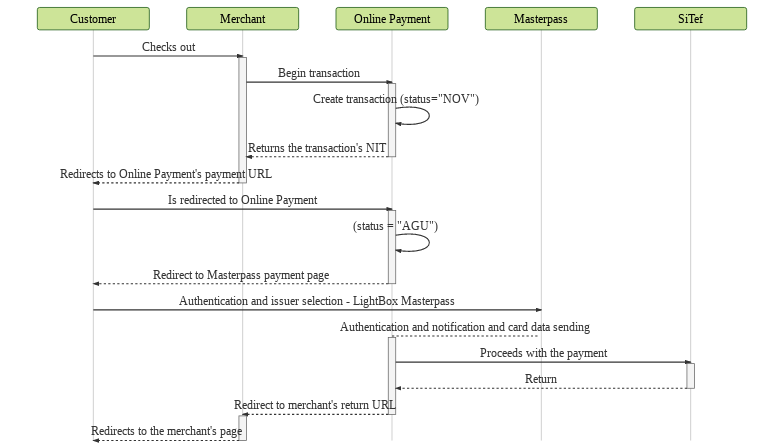
The basic payment flow using the Masterpass digital wallet starts as presented in the HTML payment integration.
The image below presents a Masterpass payment flow:
Status Notification
For each transaction status change on Carat Portal, resulting from the communication between Carat Portal and Masterpass, a status notification is sent to the merchant’s server. Learn more
Parameters for a payment transaction with the Masterpass digital wallet
The parameters used to create a payment transaction with the Masterpass digital wallet are the same as the ones presented in the HTML Payment, HTML Pre-Authorization e HTML Recharge.
Refunding Masterpass payments
The payments made on Carat Portal with the Masterpass digital wallet can be reversed using the Rest Cancel or the Merchant’s Portal.
Note that it’s required to have a card number to allow a refund. For this, it’s necessary to store the card on Carat Portal and call the cancellation service using the token / card Hash (Learn more) OR contact directly the card holder to obtain the number.
Visa Checkout
Carat Portal has Visa Checkout digital wallet as a functionality for integration with the merchant’s application.
It allows the merchant to not have any direct contact with customer card and personal data collection, using the interface and the communication structure developed by VISA for payments using this technology.
Supported routings
Currently, the Visa Checkout integration via Web Services is supported for payments routed via SiTef, Cielo e-Commerce and Stone WS.
Supported Carat Portal interfaces
The supported interfaces on Carat Portal for using Visa Checkout are:
- REST Payment
- REST Cancel
- REST Pre-Authorization
For further details about these interfaces, the merchant must have their respective integration manuals. If necessary, they must be requested to our support team.
Required configurations on Carat Portal
For a merchant to use the Visa Checkout digital wallet on Carat Portal, simply ask the Carat Portal support team to set up.
REST integration requirements
The merchant’s application must be integrated with Visa Checkout on its graphical interface and on its JavaScript callback communications to obtain the callid parameter. This field is necessary to integrate with Carat Portal’s REST payment interface.
For further details about this integration, the merchant must request the integration guide to VISA and develop the integration with the Visa Checkout Button and the LightBox.
Flows
The payment flows for using Carat Portal with Visa Checkout via Web Services assume that the merchant’s application fulfills the requirements presented in the previous item, which means that application is already capable of using Carat Portal’s Web Services with the callid.
REST payment flow
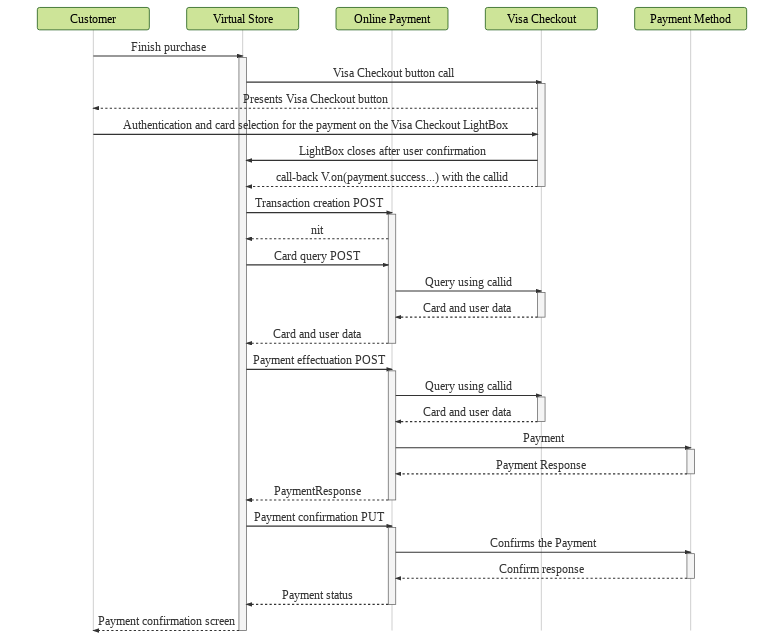
The payment flow for using Carat Portal with Visa Checkout assumes that the merchant's application is already following the requirements present in the previous item, which means that the application is capable of using Carat Portal's REST interfaces after getting the callid.
The figure below presents the sequence diagram for the integration with Carat Portal and Visa Checkout:
To pay Visa Checkout transactions via REST, the merchant's application must send the wallet_transaction_id instead of the card number in the card object. Optionally, it's also possible to send initial_wallet_transaction_id, which informs whether this is the first time that this wallet_transaction_id is being used. If it isn't defined, its default value is true. Below is an example with the cUrl application where the acquirer requests sending the security code on the payment:
To use this example, don't forget to define the variable {{url}} with the value
curl
--request POST "https://esitef-homologacao.softwareexpress.com.br/e-sitef/api/v1/payments/xxxxxxxxxxxx...xxxxxxxxxxxxx"
--header "Content-Type: application/json"
--header "merchant_id:wwwwwww"
--header "merchant_key:yyyyyyyyyyyyyyyyyyyyyy"
--data-binary
{
   "card":{
      "wallet_transaction_id":"callid_de_teste",
      "initial_wallet_transaction_id":"false",
      "security_code":"123"
   }
}
--verbose
REST pre-authorization flow
As in the REST payment, the pre-authorization interface can also receive the wallet_transaction_id and initial_wallet_transaction_id fields.
In case of payments with promotional amounts for using Visa Checkout, VISA suggests that the subtotal, discount and promo_code fields are sent additionally on the pre-authorization effectuation service and the pre-authorization capture service. Learn more.
Sending these fields isn't mandatory. However, it's extremely recommended by VISA for enriching statistical data of Visa Checkout usage and improving related services.
These fields are sent to the Visa Checkout systems along with information regarding total amount, currency and order id.
To clarify the usage of these fields, here is an example: supposing a transaction of a product which has an amount of $ 80,00, with a discount of 10% ($ 8,00) and resulting in a liquid amount of $ 72,00, the fields must be filled as follows:
amount: R$ 72,00
subtotal: R$ 80,00
discount: R$ 8,00
amount = subtotal - discount = R$ 80,00 - R$ 8,00 = R$ 72,00
REST cancel
For cancelling or reversing Visa Checkout transactions, the merchant's application must send the wallet_transaction_id instead of the card number in the card object. Below is an example with the cUrl application where the acquirer requests sending the security code:
To use this example, don't forget to define the variable {{url}} with the value
curl
--request PUT "https://esitef-homologacao.softwareexpress.com.br/e-sitef/api/v1/cancellations/xxxxxxxxxxxx...xxxxxxxxxxxxx"
--header "Content-Type:application/json"
--header "merchant_id:wwwwwww"
--header "merchant_key:yyyyyyyyyyyyyyyyyyyyyy"
--data-binary
{
   "card":{
      "security_code":"zzz",
      "wallet_transaction_id":"callid_de_teste",
   },
   "amount":"1000"
}
--verbose
AME
This documentation describes the integration with AME through Carat Portal, using the CardSE via SiTef routing.
Registration information
The Carat must be configured to accept payments for the AME authorizer thru CardSE.
REST Payment
Flow
sequenceDiagram
    participant C as Customer
    participant L as Merchant
    participant E as Online Payment
    participant A as Authorizer
    C->>+L: Checkout
    L->>+E: 1. Creates Transaction
    E-->>-L: nit
    L->>+E: 2. Performs payment(nit)
    E-->>-L: PEN status, QR code
    L-->>-C: 3. Displays QR code
    C->>+A: 4. Scans QR code
    A-->>-C: Payment Confirmation
    E->>+A: 5. Query payment
    A-->>-E: Payment confirmed
    L->>+E: 6. Query transaction
    E-->>-L: CON status
- The merchant creates the transaction on Carat Portal passing some additional AME information and receives a NIT as a response.
- The merchant calls the payment effectuation service and receives a QR code and a transaction with
PEN(pending) status. - The merchant displays the QR code to the customer.
- The customer scans the QR code with the AME app and goes through the payment confirmation procedures requested by the authorizer.
- While the customer finishes the payment, Carat Portal will query the sale situation on the authorizer until the transaction ends.
- The merchant, in turn, must query the transaction status on Carat Portal until it doesn't have the
PENstatus anymore.
Attention:
If the status remains pending (
PEN) after 3 (three) minutes, Carat Portal will undo the transaction alongside AME.
Additional information when creating the transaction
For AME transactions, the authorizer_id = 446 must be used.
Below are the additional parameters that can be sent on AME transactions:
| Parameter | Description | Format | Mandatory | |||
|---|---|---|---|---|---|---|
| additional_data.items[] | ||||||
ean | EAN product code. Attention: if EAN and SKU are sent simultaneously, only EAN will be considered. | < 255 AN | NO | |||
sku | SKU product code. Attention: if EAN and SKU are sent simultaneously, only EAN will be considered. | < 255 AN | NO | |||
description | Product description. | < 30 AN | NO | |||
quantity | Product quantity. | < 15 N | NO | |||
quantity_type | Quantity type:
| < 2 AN | NO | |||
unit_price | Unit price of the product in cents. | < 12 N | NO | |||
Example:
Starting transaction
--request POST "https://esitef-homologacao.softwareexpress.com.br/e-sitef/api/v1/transactions"
--header "Content-Type: application/json"
--header "merchant_id: xxxxxxxx"
--header "merchant_key: xxxxxxxxxxx"
--data-raw '
{
   "merchant_usn":"12042142155",
   "order_id":"1651001767957",
   "installments":"1",
   "installment_type":"4",
   "authorizer_id":"446",
   "amount":"1000",
	"additional_data": {
		"items": [
			{
				"quantity": "1",
				"quantity_type": "u",
				"unit_price": "50000",
                "ean": "9283746529385",
				"description": "bola para jogar 1"
			},
			{
				"quantity": "2",
				"quantity_type": "u",
				"unit_price": "25000",
                "ean": "9283746529384",
				"description": "bola para jogar 2"
			}
		]
	}
}'
Payment effectuation request
When using AME, it won't be necessary to send any card data.
Example:
--request POST "https://esitef-homologacao.softwareexpress.com.br/e-sitef/api/v1/payments/1234567890abcdefghijklmnopqrstuvwxyz1234567890abcdefghijklmnopqr"
--header "Content-Type: application/json"
--header "merchant_id: xxxxxxxx"
--header "merchant_key: xxxxxxxxxxx"
--data-raw '
{
}
Payment effectuation response with non-standard size
| Parameter | Description | Format |
|---|---|---|
authorization_number | Authorization number. | < 100 AN |
Attention:
In case of a communication failure in this operation, it will be necessary to create another transaction.
Example:
    "code": "0",
    "message": "OK. Transaction successful.",
    "payment": {
        "authorizer_code": "000",
        "status": "PEN",
        "nit": "a479f7d0fc3e3bdfe22f489298b9ca56fa98c4c7c56e2529eb4fddb44c7a392c",
        "order_id": "1651003189064",
        "authorizer_id": "446",
        "acquirer_id": "271",
        "acquirer_name": "CardSE",
        "authorizer_date": "26/04/2022T16:59",
        "authorization_number": "111111111122222222223333333333444444444455555555556666666666                                        ",
        "merchant_usn": "12042142155",
        "esitef_usn": "220426096883310",
        "sitef_usn": "265428",
        "host_usn": "000000000   ",
        "amount": "1000",
        "payment_type": "O",
        "authorizer_merchant_id": "084675745000140",
        "terminal_id": "ES000041",
        "payment_date": "26/04/2022T16:59",
        "qr_code": "The quick brown fox jumps over the lazy dog"
    }
}
HTML Payment
There are no flow differences to the merchant.
As in the REST Payment, additional parameters on the transaction creation can be sent, using the same format.
REST Cancel
Cancel request
When using AME, it won't be necessary to send any card data.
Example:
--request PUT "https://esitef-homologacao.softwareexpress.com.br/e-sitef/api/v1/cancellations/1234567890abcdefghijklmnopqrstuvwxyz1234567890abcdefghijklmnopqr"
--header "Content-Type: application/json"
--header "merchant_id: xxxxxxxxxxx"
--header "merchant_key: xxxxxxxxxxx"
--data-raw '{
}'
Cancel response parameters
{
    "code": "0",
    "message": "OK. Transaction successful.",
    "cancellation": {
        "authorizer_code": "000",
        "authorizer_message": "Lojista OK",
        "status": "CON",
        "nit": "1234567890abcdefghijklmnopqrstuvwxyz1234567890abcdefghijklmnopqr",
        "order_id": "1651003189064",
        "customer_receipt": "=== COMPROVANTE ===",
        "merchant_receipt": "=== COMPROVANTE ===",
        "authorizer_id": "446",
        "acquirer_id": "1271",
        "acquirer_name": "CardSE",
        "authorizer_date": "26/04/2022T17:12",
        "authorization_number": "265429",
        "merchant_usn": "12042142155",
        "esitef_usn": "220426096883331",
        "sitef_usn": "265429",
        "host_usn": "00000000000004265429          ",
        "amount": "1000",
        "payment_type": "O",
        "authorizer_merchant_id": "084675745000140",
        "esitef_date": "26/04/2022T17:12",
        "is_host_cancel": "false"
    }
}
Generate payment link on the Merchant's Portal
It's also possible to make AME payments using the payment link functionality of the Merchant's Portal. However, additional AME information cannot yet be sent.
VEE Via CardSE
This documentation describes the integration with the VEE digital wallet through Carat Portal, using the CardSE via SiTef routing.
Flow
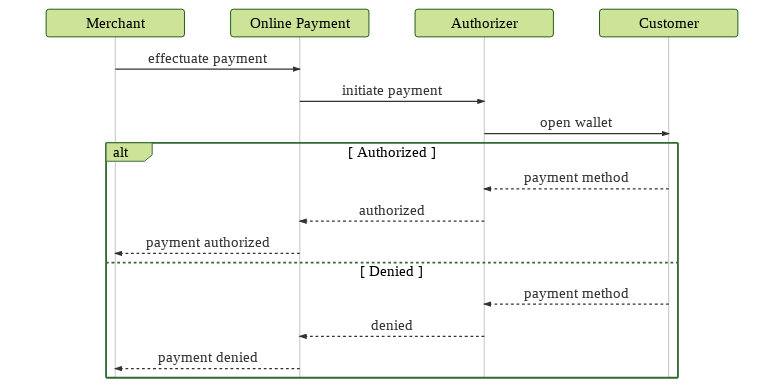
- The merchant effectuates the payment in Carat Portal, informing the transaction token generated by the customer's VEE app. This token must be sent to Carat Portal's
card.wallet_transaction_idfield. Learn more about REST Payment request parameters. - Carat Portal initiates the payment with the VEE authorizer, informing the transaction token.
- VEE opens the digital wallet in the customer's app.
- The customer chooses the payment method and confirms the purchase through the VEE app.
- The authorizer sends the response to Carat Portal, approving or denying the transaction.
- Carat Portal forwards the authorizer's response to the merchant.
Flow without customer's delay
Attention:
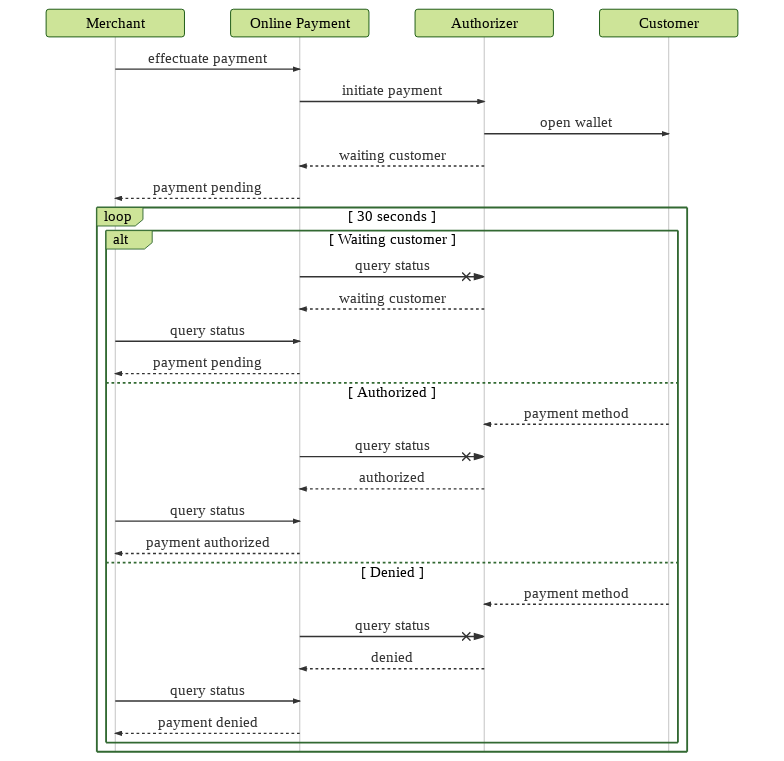
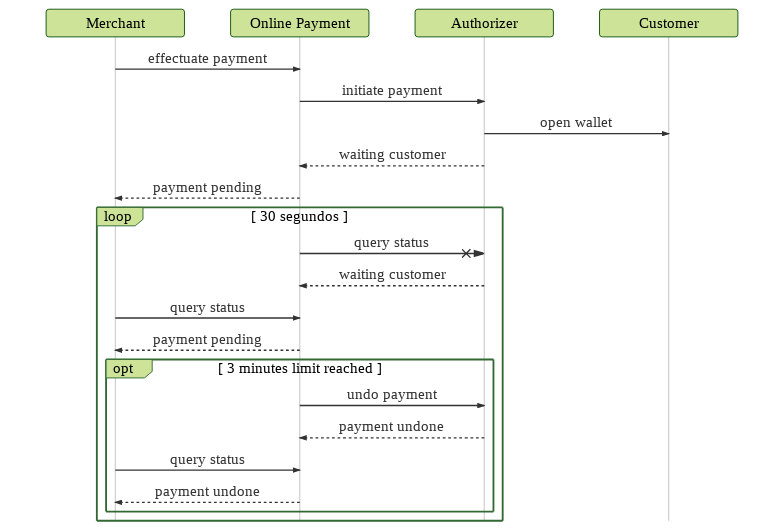
If the customer takes too long to choose the payment method, the transaction will be set to pending (PEN) and Carat Portal will start a loop with an approximately 30 seconds interval to query the transaction status until it is resolved.
During the loop, the merchant must query the status of the transaction on Carat Portal by doing a transaction status query.
If the transaction status is still pending after approximately 3 (three) minutes, Carat Portal will undo the transaction along with the VEE authorizer.
Flow with customer's delay and status resolved before time limit
Flow with customer's delay and time limit reached
PayPal
This document goal is show the required configurations and guidelines to make possible merchant integration with PayPal by Carat Portal HTML Interface, and Carat Portal Merchant's Portal and Web Services for Refunding.
Carat Portal supported interfaces for integration
The following interfaces are available for Integrations using PayPal:
- HTML Payment Interface 2.0
- Refund Web Service
- Refunding by Carat Portal Merchant's Portal
PayPal authorizer id code in Carat Portal
The authorization code for using PayPal is 400. For more authorizer codes, visit the Authorizers page.
Required Configurations
Before start making transactions using PayPal in Carat Portal, merchants must follow the steps below.
Merchant's account data at PayPal
The store must create a PayPal account if you no longer have it. More information at www.paypal.com.br. Follow the instructions at Create PayPal Account. Within your account, create the required credentials.
PayPal allows from the registered Business account to create virtual accounts for the sandbox - PayPal's testing environment. For the Carat Portal homologation process, it is suggested that an account be created in the sandbox. Look for the option on the website within your PayPal account.
The Table below show then required PayPal credentials:
| Field name in Carat Portal | Field description | Mandatory |
|---|---|---|
| USER | User name on PayPal account. | YES |
| PWD | USER's password. | YES |
| SIGNATURE | USER's signature. | YES |
Note: Sandbox account data can be used in Carat Portal test and Certification environment, but in Carat Portal Production environment, merchant must use real PayPal account data.
Register PayPal account data in Carat Portal
Merchant must contact Carat Portal Support Team to register PayPal account data at Carat Portal, and the additional
steps below is required:
- PayPal authorizer activation in merchant account in Carat Portal;
- Username and password to access Carat Portal Merchant's Portal.
For more information, go to the Authorizer Configuration in the Merchant's Portal page.
Header Image and customized logo in PayPal page
Merchants can choose on using customized logo and/or header image in PayPal payment page. Logo size must be 190 pixels x 60 pixels and header image size must be 915 pixel x 85 pixels.
Merchant logo and header image must be submitted to PayPal support team to validation and combination with Carat Portal logo.
Payment Flow with PayPal
Carat Portal uses PayPal's Express Checkout API to payment integration.
The common payment flow using Carat Portal to integrate with PayPal API is described in steps below:
- The user starts payment in Carat Portal;
- Configured authorizers for mechant are presented to the user;
- The user choose PayPal;
- At this moment a new window opens, redirecting the user to PayPal page;
- The user starts payment process in PayPal page, where authentication and authorization occours;
- The user ends payment in PayPal environment;
- PayPal redirects user back to Carat Portal;
- After receiving redirected user, Carat Portal makes a query on PayPal and updates the transaction status on Carat Portal;
- If the merchant configured automatic redirecting in Carat Portal, the user is automatic redirected to registered Success URL or Failure URL.
The input/output diagram below shows a PayPal payment flow via Carat Portal:
sequenceDiagram
There is only one case where this flow is different, when transaction begin is made with pre-fixed PayPal authorizer. In this case, steps 2 and 3 is not necessary.
Status Notification
For each transaction status change in Carat Portal resulting from communication between Carat Portal and PayPal, a Status Notification is sent to the merchant's server. For more details, see the Status Notification page.
Transaction required parameters for PayPal payments in Carat Portal
The parameters used to create a payment transaction with PayPal are the same as those presented in the HTML Payment Transaction Creation document.
In addition to the common parameters, it is possible to send in the request the specific fields for Paypal described below:
| Parameter | Description | Size | Mandatory |
|---|---|---|---|
additional_data | ADDITIONALDATA object. | NO |
ADDITIONALDATA (additional_data)
additional_data)| Parameter | Description | Size | Mandatory |
|---|---|---|---|
extra_info | Additional info about payment. | < 127 AN | NO |
item_amount | Order items amount summary, in cents. This summary must match unit_price field value multiplied by quantity field value, for all items. Maximum value allowed is US$10000, in any currency. | < 1024 N | NO |
purchase_summary | Customizeable text to "Purchase Summary" field in Carat Portal payment screen. | < 1024 AN | NO |
insurance_amount | Order items insurance amount, in cents. Maximum value allowed is US$10000, in any currency. | < 1024 N | NO |
handling_amount | Sale handling amount, in cents. Maximum value allowed is US$10000, in any currency. | < 1024 N | NO |
tax_amount | Order total tax amoutn summary, in cents. Maximum value allowed is US$10000, in any currency. | < 1024 N | NO |
items | ITEMS object array. | NO | |
payer | PAYER object. | NO | |
shipment | SHIPMENT object. | NO | |
extra_param | EXTRAPARAM object. | NO |
ITEMS (items)
items)| Parameter | Description | Size | Mandatory |
|---|---|---|---|
id | Item identification code. | < 127 AN | NO |
title | Item title. | < 127 AN | NO |
url | Item URL. | < 1024 AN | NO |
quantity | Item quantity. | < 10 N | NO |
unit_price | Item unit price, in cents. Maximum value allowed is US$10000, in any currency. | < 1024 N | NO |
weight | Item unit weight, in grams (g). Ex: 2,3 kg -> 2300. | < 10 N | NO |
description | Item description. | < 127 AN | NO |
tax_amount | Item unit tax amount, in cents. Maximum value allowed is US$10000, in any currency. | < 1024 N | NO |
length | Item length, in centimeters (cm). | < 10 N | NO |
width | Item width, in centimeters (cm). | < 10 N | NO |
height | Item height, in centimeters (cm). | < 10 N | NO |
type | Item type:Digital – The item is a digital product. Ex: e-books, songs, etc.Physical – The item is a physical product. | < 10 N | NO |
PAYER (payer)
payer)| Parameter | Description | Size | Required |
|---|---|---|---|
email | Customer / Payer e-mail address. | < 127 AN | NO |
identification_type | Customer / Payer identification type. For Brazil:BR_CPF - Buyer's CPF BR_CNPJ - Buyer's CNPJ. | < 10 A | YES (FOR BRAZIL) |
identification_number | Customer / payer identification number. | < 14 AN | YES (FOR BRAZIL) |
SHIPMENT (shipment)
shipment)| Parameter | Description | Size | Mandatory |
|---|---|---|---|
cost | Order total shipment cost. Format: cents. Maximum value allowed is US$10000, in any currency. Ex: 123456 (R$ 1234,56) | < 1024 N | NO |
discount_amount | Shipment cost discount amount, in cents. Maximum value allowed is US$10000, in any currency. | < 1024 N | NO |
receiver_address | RECEIVERADDRESS object. | NO |
RECEIVERADDRESS (receiver_address)
receiver_address)| Parameter | Description | Size | Required |
|---|---|---|---|
zip_code | Receiver address zip code (or CEP for Brazil). | < 20 AN | SIM (*) |
street_name | Receiver address street name. Maximum size allowed, combined with street_number field, is 100 characters. | < 100 AN | SIM (*) |
street_number | Receiver address number. Maximum size allowed, combined with street_address field, is 100 characters. | < 100 AN | SIM (*) |
complement | Receiver address complement (block, apartment, etc.). | < 100 AN | SIM (*) |
city | Receiver address city. | < 40 AN | SIM (*) |
state | Receiver address state. Example in Brazil: SC (Santa Catarina), SP (São Paulo), etc. | < 2 AN | SIM (*) |
country | Receiver address country code, using ISO 3166-1 alpha-3 (3 letters). Ex: Brazil: BRA | < 2 A | SIM (*) |
name | Receiver reference name. | < 32 AN | SIM (*) |
phone_area_code | Receiver address phone area code. Maximum size allowed, combined with phone_number field, is 20 characters. | < 20 AN | SIM (*) |
phone_number | Receiver address phone number. Maximum size allowed, combined with phone_area_code field, is 20 characters. | < 20 AN | SIM (*) |
EXTRAPARAM (extra_param)
extra_param)| Parameter | Description | Size | Mandatory |
|---|---|---|---|
acquirer_params | ACQUIRERPARAMS object. | NO |
ACQUIRERPARAMS (acquirer_params) (**)
acquirer_params) (**)| Parameter | Description | Size | Mandatory |
|---|---|---|---|
key | Parameter key to send to acquirer/authorizer. | < 1024 AN | NO |
value | Parameter value to send to acquirer / authorizer. | < 1024 AN | NO |
(*) This field is not required if the product item is a digital product (see item object, type field), so there is no product delivery. Ex: e-books, digital songs, etc.
NOTE: The field that defines whether the item is digital or not is the
typefield of theitemobject.
(**) acquirer_params: This field groups key + value format parameters, to specific acquirer parameters. In PayPal case, the following parameters can be sent here:
| Key | Value |
|---|---|
reqConfirmShipping | Indicates whether or not merchant with PayPal be a confirmed address. For digital products, this field is required, and merchant must set it to 0 (zero). It is one of the following values:0 - Merchant do not require the buyer's shipping address be a confirmed address;1 - Merchant require the buyer's shipping address be a confirmed address;For digital or virtual products (eg electronic books and digital music - products that are delivered via the web), the parameter is required and must be set to 0 (zero). |
noShipping | Determines where or not PayPal displays shipping address fields on the PayPal pages. For digital goods, this field is required, and merchant must set it to 1. It is one of the following values:0 - PayPal displays the shipping address on the PayPal pages; 1 - PayPal does not display shipping address fields whatsoever;2 - If merchant do not pass the shipping address, PayPal obtains it from the buyer's account profile. |
allowNote | Enables the buyer to enter a note to the merchant on the PayPal page during checkout. It is one of the following values:0 - The buyer is unable to enter a note to the merchant;1 - The buyer is able to enter a note to the merchant. |
addrOverride | Determines whether or not the PayPal pages should display the shipping address set by merchant in request, not the shipping address on file with PayPal for this buyer. Displaying the PayPal street address on file does not allow the buyer to edit that address. It is one of the following values:0 - The PayPal pages should not display the shipping address;1 - The PayPal pages should display the shipping address. |
localeCode | Locale of pages displayed by PayPal during Express Checkout. It is one of the following values supported by PayPal:AU - Australia AT - Austria BE - Belgium BR - Brazil CA - Canada CH - Switzerland CN - China DE - Germany ES - Spain GB - United Kingdom FR - France IT - Italy NL - Netherlands PL - Poland PT - Portugal RU - Russia US - United States For country-specific languages: da_DK - Danish (only for Denmark) he_IL - Hebrew (all the locations) id_ID - Indonesian (Indonesia only) jp_JP - Japanese (Japan only) no_NO - Norwegian (Norway only) pt_BR - Brazilian Portuguese (only for Portugal and Brazil) ru_RU - Russian (for Lithuania, Latvia, and Ukraine) sv_SE - Swedish (only for Sweden) th_TH - Thai (Thailand only) tr_TR - Turkish (Turkey Only) zh_CN - Simplified Chinese (C only) hina) zh_HK - Traditional Chinese (Hong Kong Only) zh_TW - Traditional Chinese (Taiwan Only)NOTE: If the locale code is not supplied or the supplied value is not one of the above-listed values, it is defaulted by PayPal. The default is determined using information about the current merchant, user, and other information for the session. |
pageStyle | Name of the Custom Payment Page Style for payment pages associated with this button or link. It corresponds to the HTML variable page_style for customizing payment pages. Max 30 alphabetic characters. |
hdrBorderColor | Sets the border color around the header of the payment page. The border is a 2-pixel perimeter around the header space, which is 750 pixels wide by 90 pixels high. By default, the color is black. Max 6-character HTML hexadecimal ASCII color code. |
hdrBackColor | Sets the background color for the header of the payment page. By default, the color is white. Max 6-character HTML hexadecimal ASCII color code. |
payFlowColor | Sets the background color for the payment page. By default, the color is white. Max 6-character HTML hexadecimal ASCII color code. |
cartBorderColor | The HTML hex code for merchant's principal identifying color. PayPal blends merchant's color to white in a gradient fill that borders the cart review area of the PayPal checkout user interface. Max 6-character HTML hexadecimal ASCII color code. |
landingPage | Type of PayPal page to display. It is one of the following values:Billing - Non-PayPal account;Login - PayPal account login.Default value is Login. |
buyerEmailOptinenable | Enables the buyer to provide their email address on the PayPal pages to be notified of promotions or special events. Is one of the following values:0 - Do not enable buyer to provide email address;1 - Enable the buyer to provide email address. |
paymentRequest_0_paymentReason | Indicates the type of transaction. It is one of the following values:None - Transaction is not identified as a particular type;Refund - Identifies the transaction as a refund. |
paymentRequest_0_insuranceOptionOffered | Indicates whether insurance is available as an option the buyer can choose on the PayPal Review page. Merchant can specify up to 10 payments, where n is a digit between 0 and 9 , inclusive. Is one of the following values:true - With option.false - Without option. |
paymentRequest_0_custom | A free-form field for merchant use. Merchant can specify up to 10 payments, where n is a digit between 0 and 9, inclusive. Max 256 alphanumeric characters |
paymentRequest_0_noteText | Note to the merchant. Merchant can specify up to 10 payments, where n is a digit between 0 and 9 , inclusive. Max 255 characteres. |
Important: Despite of PayPal support for multiple item groups, Carat Portal supports only one item group in a single payment.
JSON request examples to begin PayPal transaction in Carat Portal
Below are shown request examples to begin a PayPal transaction in Carat Portal.
Minimum request example:
Minimum request JSON object:
{
  "merchant_id": "CODIGOLOJA",
  "amount": "1000",
  "authorizer_id": "400",
  "additional_data": {
    "currency": "BRL",
    "payer": {
      "identification_type": "BR_CPF",
      "identification_number": "12345678901"
    }
  }
}
Complete request example:
{
  "merchant_id": "CODIGOLOJA",
  "merchant_usn": "1234567890",
  "order_id": "pedido45687",
  "authorizer_id": "400",
  "amount": "1000",
  "redirect": "M",
  "style": "P",
  "soft_descriptor": "MINHALOJA",
  "additional_data": {
    "item_amount": "1000",
    "tax_amount": "0",
    "insurance_amount": "0",
    "handling_amount": "0",
    "extra_info": "descricao",
    "currency": "BRL",
    "items": [
      {
        "id": "1",
        "title": "bola 1",
        "quantity": "1",
        "unit_price": "500",
        "currency": "BRL",
        "url": "http://sportv.globo.com/platb/files/1103/2011/08/bola_futebol.gif",
        "type": "Physical",
        "description": "bola para jogar 1",
        "weight": "100",
        "length": "20",
        "width": "20",
        "height": "20",
        "tax_amount": "0"
      },
      {
        "id": "2",
        "title": "bola 2",
        "quantity": "2",
        "unit_price": "250",
        "currency": "BRL",
        "url": "http://sportv.globo.com/platb/files/1103/2011/08/bola_futebol.gif",
        "type": "Physical",
        "description": "bola para jogar 2",
        "weight": "200",
        "length": "20",
        "width": "20",
        "height": "20",
        "tax_amount": "0"
      }
    ],
    "payer": {
      "email": "[email protected]",
      "identification_type": "CPF",
      "identification_number": "09719224703"
    },
    "shipment": {
      "cost": "0",
      "discount_amount": "0",
      "receiver_address": {
        "zip_code": "12345678",
        "street_number": "Rua do Exemplo",
        "street_name": "123",
        "name": "Rafael do Mel",
        "phone_area_code": "11",
        "phone_number": "912341234",
        "city": "São Paulo",
        "complement": "Sobreloja 3",
        "country": "BRA",
        "state": "SP"
      }
    },
    "extra_param": {
      "acquirer_params": [
        {
          "key": "reqConfirmShipping",
          "value": "0"
        },
        {
          "key": "noShipping",
          "value": "1"
        },
        {
          "key": "allowNote",
          "value": "1"
        },
        {
          "key": "addrOverride",
          "value": "1"
        },
        {
          "key": "localeCode",
          "value": "pt_BR"
        },
        {
          "key": "pageStyle",
          "value": ""
        },
        {
          "key": "hdrBorderColor",
          "value": ""
        },
        {
          "key": "hdrBackColor",
          "value": ""
        },
        {
          "key": "payFlowColor",
          "value": ""
        },
        {
          "key": "cartBorderColor",
          "value": ""
        },
        {
          "key": "landingPage",
          "value": ""
        },
        {
          "key": "buyerEmailOptinenable",
          "value": "0"
        },
        {
          "key": "paymentRequest_0_paymentReason",
          "value": "none"
        },
        {
          "key": "paymentRequest_0_insuranceOptionOffered",
          "value": "false"
        },
        {
          "key": "paymentRequest_0_custom",
          "value": ""
        },
        {
          "key": "paymentRequest_0_noteText",
          "value": "Obrigado por comprar na Loja Teste!"
        }
      ]
    }
  }
}
PayPal transactions cancelling
The PayPal transaction cancelling or refunding are available in Carat Portal at two interfaces:
Refund using Merchant's Portal
When cancelling a PayPal transaction via Merchant's Portal the following screen will be displayed during the process:
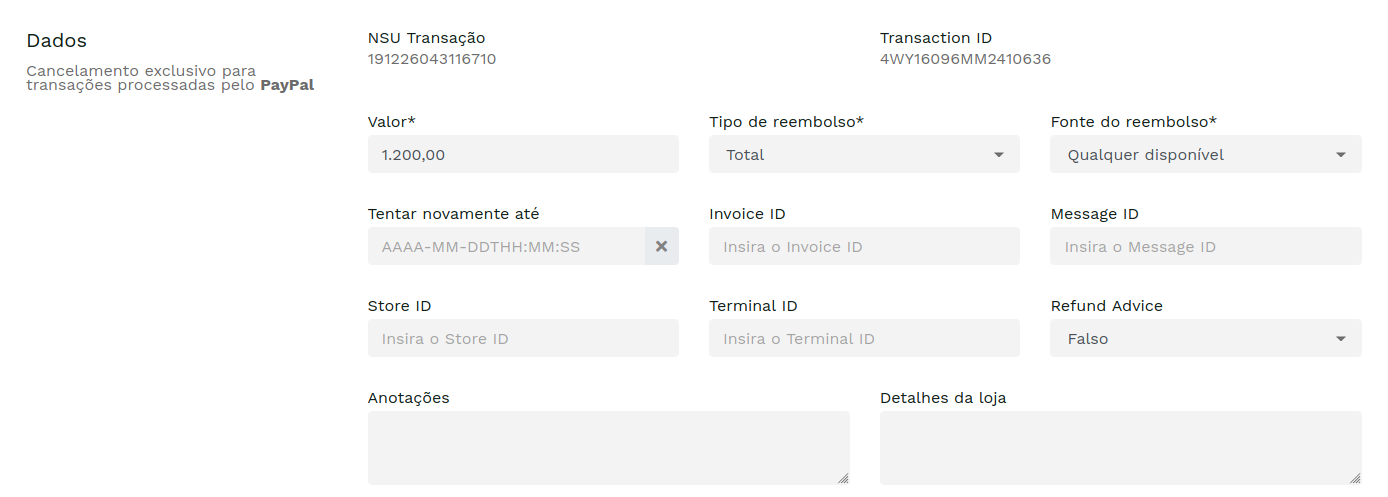
The following table shows the description of the form fields:
| Parameter | Description | Mandatory |
|---|---|---|
Valor | Refund amount. | YES |
Tipo de Reembolso | Type of refund the merchant is making. Allowed values: Total - Full refund.Parcial - Partial refund. | YES |
Fonte do Reembolso | Type of PayPal funding source (balance or eCheck) that can be used for auto refund Allowed values: Qualquer disponível - The merchant does not have a preference. Use any available funding source.Padrão - Use the merchant's preferred funding source, as configured in the merchant's profile.Imediato - Use the merchant's balance as the funding source.eCheck - The merchant prefers using the eCheck funding source. If the merchant's PayPal balance can vocer the refund amount, use the PayPal balance. | YES |
Tentar novamente até | Format: YYYY-MM-DDTHH:MM:SS. Maximum time until merchant must retry the refund. | NO |
Invoice ID | Merchant invoice or tracking number. | NO |
Message ID | A message ID used for idempotence to uniquely identify a message. This ID can later be used to request the latest results for a previous request without generating a new request. Examples of this include requests due to timeouts or errors during the original request. | NO |
Store ID | Identifier of the merchant store at which the refund is given. This field is required for point-of-sale transactions. | NO |
Terminal ID | ID of the terminal, in point-of-sale transactions. | NO |
Refund Advice | Flag to indicate that the buyer was already given store credit for a given transaction. Allowed values: Verdadeiro - The buyer was already given store credit for a given transaction.Falso - The buyer was not given store credit for a given transaction. | NO |
Anotações | Custom memo about the refund. | NO |
Detalhes da loja | Information about the merchant store. | NO |
Google Pay
Google Pay allows your customers to store payment methods in their own Google account for faster and more secure payments.
How it works
When the customer clicks the Google Pay payment button, the payment methods saved to their Google account are displayed. The customer can quickly select the desired payment method and optionally fill in additional purchase information. After this interaction with Google Pay, these same data will be sent / processed by the Carat Portal for payment flow.
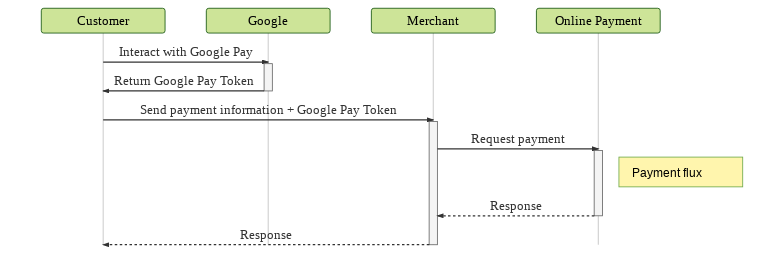
Google Pay is supported by Carat Portal, however it is not supported by all acquirers and is not enabled by default in your account. Contact a member of our support team for more information.
Attention: By using Google Pay through Carat Portal, the merchant must be aware of and adhere to the Acceptable Use Policy and accept the Google Pay API Terms of Service.
REST Payment
Integrate with Google Pay
To start processing payments with Google Pay, you need to integrate with Google via Web or Android. During the integration you will see that some parameters are required to process Google Pay through Carat Portal:
- The
gatewayMerchantIdparameter must be populated with the merchant's merchant_id in Carat Portal; - The
gatewayparameter must be filled withsoftwareexpress;
Below is an excerpt of integration via web that needs to be configured with Carat Portal data:
const tokenizationSpecification = {
  type: 'PAYMENT_GATEWAY',
  parameters: {
    gateway: 'softwareexpress',
    gatewayMerchantId: '<ESITEF_MERCHANT_ID>',
  },
};
Below is an excerpt of integration via Android that needs to be configured with Carat Portal data:
.setPaymentMethodTokenizationType(WalletConstants.PAYMENT_METHOD_TOKENIZATION_TYPE_PAYMENT_GATEWAY)
.addParameter("gateway", "softwareexpress")
.addParameter("gatewayMerchantId", "<ESITEF_MERCHANT_ID>")
The following card networks available on Google Pay are supported by Carat Portal: VISA, ELECTRON, MASTERCARD, MAESTRO, ELO, ELO_DEBIT, AMEX, DISCOVER and JCB. The following authorization methods available on Google Pay are supported by Carat Portal: PAN_ONLY and 3DS_CRYPTOGRAM. Contact our support team to activate the proper settings for your merchant.
In addition, the store must follow Google Pay layout guidelines. See the Google Pay documentation for brand guidelines.
The screens below shows a Web buy flow recommended by Google Pay.
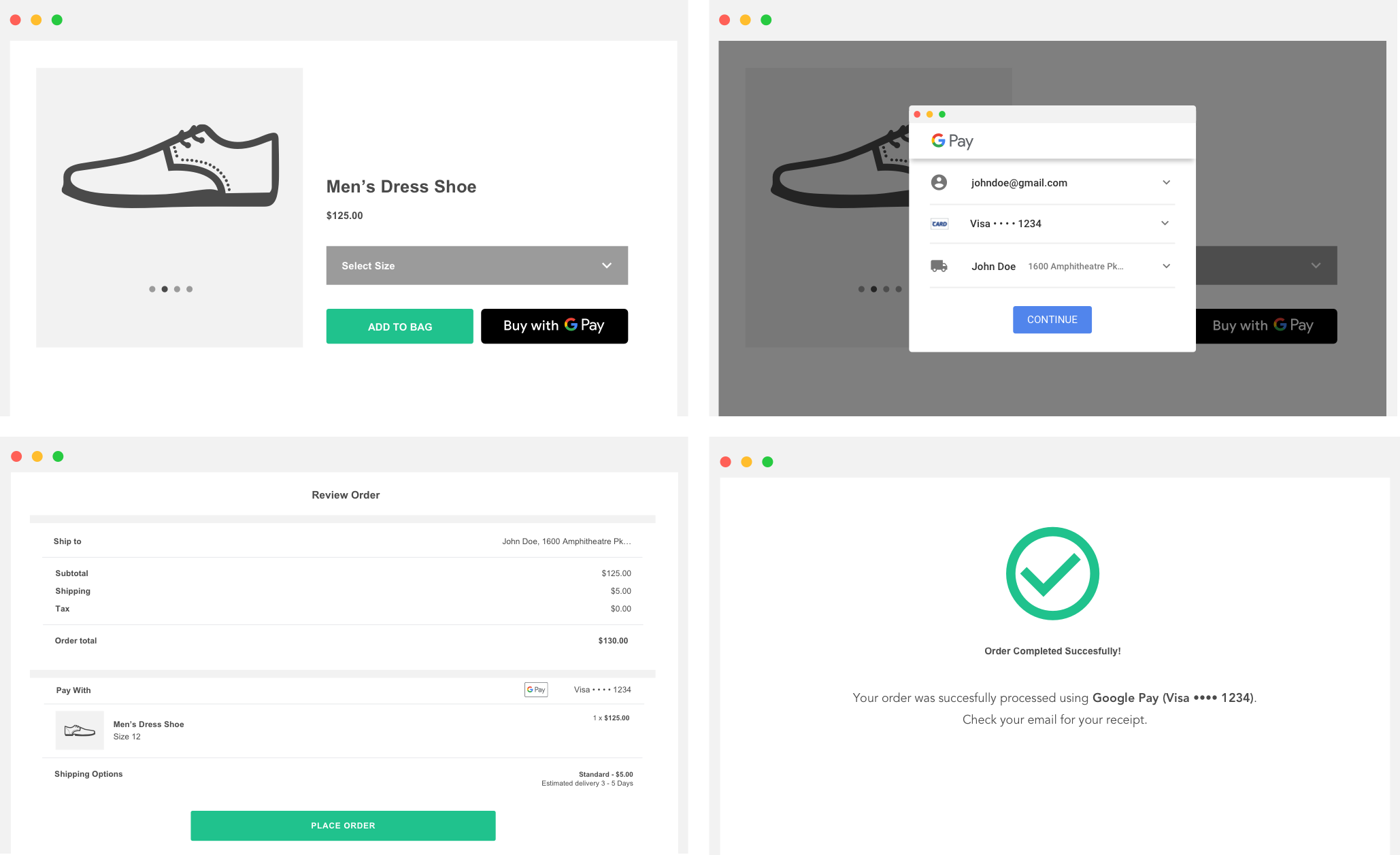
The screens below shows an Android buy flow recommended by Google Pay.
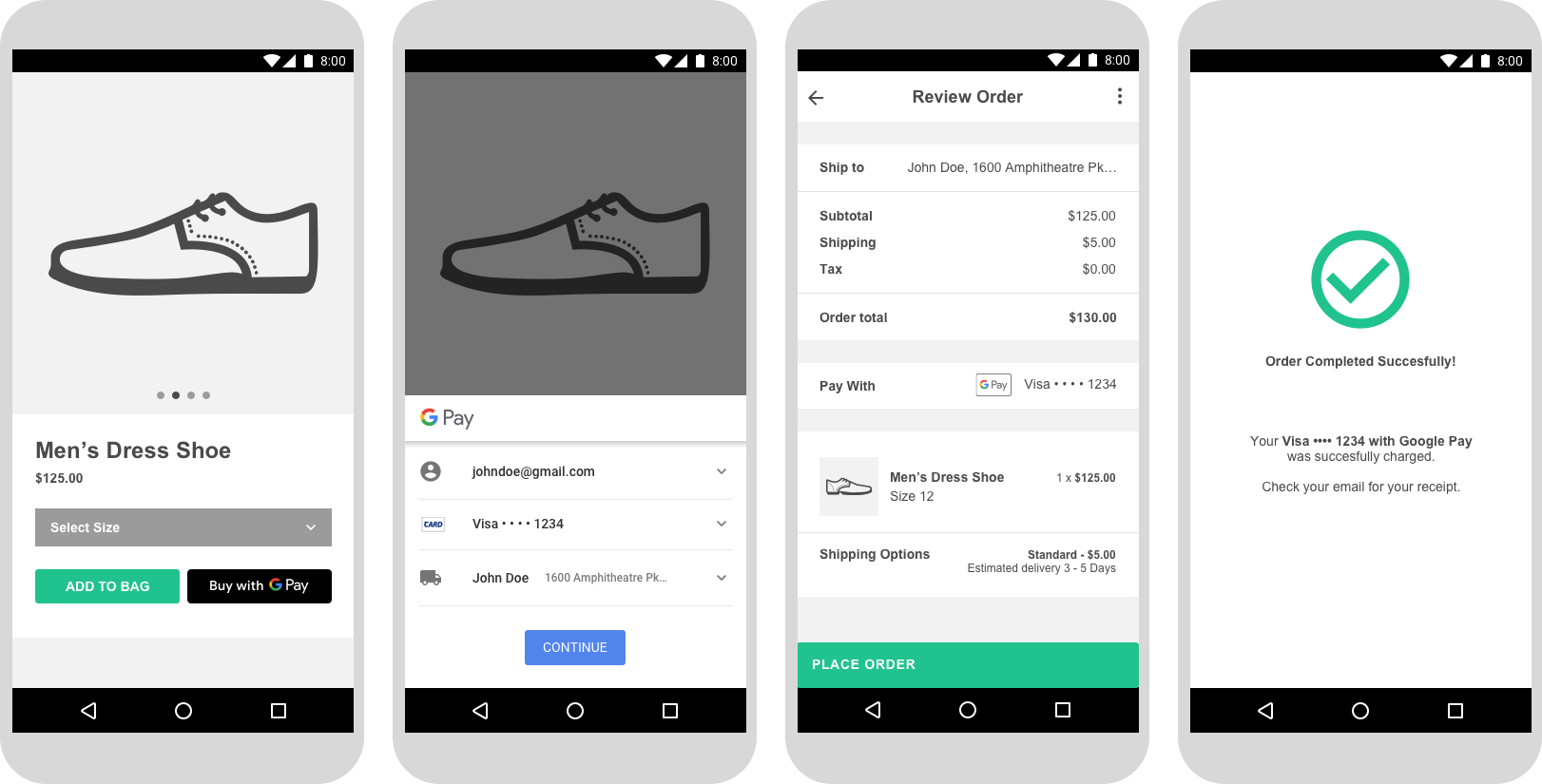
Send data to Carat Portal
When you complete your integration with Google, you will have all the information you need to make a payment with Carat Portal.
Google will respond with the PaymentData response, which includes the encrypted load (token).
From the Google response containing the customer information, extract the token, following the API reference to properly extract the token from the response. Currently, the token can be extracted from paymentData.paymentMethodData.tokenizationData.token. Use this token on payment effectuation request in the card.wallet_transaction_id field. Additionally this, will be necessary to send the field paymentData.paymentMethodData.info.cardNetwork to the field wallet_returned_card_brand. Below is an example of this request:
The content of
paymentData.paymentMethodData.tokenizationData.tokenis equivalent to a JSON, but there is no need to handle this content. Pass the value obtained without performing any treatment to thecard.wallet_transaction_idfield.
To use this example, don't forget to define the variable {{url}} with the value
curl  -X POST \
  https://esitef-homologacao.softwareexpress.com.br/e-sitef/api/v1/payments/<NIT> \
  --header "Content-Type: application/json" \
  --header "merchant_id: <MERCHANT_ID>" \
  --header "merchant_key: <MERCHANT_KEY>" \
  --data-binary '{
    "authorizer_id": "405",
    "card": {
        "wallet_transaction_id": "{\"signatures\":\"MEUCIH1PBdMmbWMvaR/ArH08R/OT41Or2yfLqbzj2JG9VGfJAiEA+6NPKT6sAKZeaLacm29wIS8v2tUwPE281JuRBf81imo\\u003d\",\"intermediateSigningKey\":{\"signedKey\":\"{\\\"keyValue\\\":\\\"MFkwEwYHKoZIzj0CAQYIKoZIzj0DAQcDQgAEm1j1auejJXFzexs/H3TasImWFERsifrx93W7wxZb0dpLxk/FaK8hQN6Ypwep8DaYrEKSp6zvxeE4ezDrssf/Bg\\\\u003d\\\\u003d\\\",\\\"keyExpiration\\\":\\\"1576347458323\\\"}\",\"signatures\":[\"MEYCIQCbAolg3/K2yD0/p3K7gRFhXva79STrj+rZcYp/3vi6ogIhANGT/9GkO9S1lJtnu3C6QQ/kFSR2wxtPJRGfuqSKs9FE\"]},\"protocolVersion\":\"ECv2\",\"signedMessage\":\"{\\\"encryptedMessage\\\":\\\"Dcm8wxtB6Bp7CyHV1OBqTskStqX3K5x7I0fV/2V0KsMLkZHP5nn+IXC+HBLkZtPF0Ov6uBD1eLbOB2KQd1cVmBPm7f4xSsB4DaYTktfk2AaLpR0BZlb9errv4jl4QAxSLdxw8Hk3EKicSmvsUNE2SzFBOONPrvv1qe03ZnzB3Q0ID1ocsBJ09PQ/2jft0WY/Py6iAA4sccZKmxLdo83NJJc1VrfcGLcqwy5InUV4nSxmXrnr/eNQDIx9p4Yf3RSVlS6/t+bEpUjpUSwSNoHwzhlWOve3/Gm+yt+OKheXOWSsXiHJL1rV1ENgDroR2uMUb85OZCF1ulStb6U8xocRVKSKkhAxFVUehz568huQdlEjns+5MMWdZkNgH3cXMgTQxZ6DiUYxMthUhdT8HINXCUYxaT/od/Njh2JZHJb2R4u4HsfViUoIVRHojSaepXP3KI2z4G9hPwKX/MWeEMyiZRUiCHHe0VJoU/8xxg\\\\u003d\\\\u003d\\\",\\\"ephemeralPublicKey\\\":\\\"BG0eCJ8xbPN55ht7b3oDZgFgwG4rZxkRWrOFnmW9wwxUrZS0A6oeMAySLKThMydaGuoTbbiAwK38zx8pnNKgirA\\\\u003d\\\",\\\"tag\\\":\\\"uPvitOn+aGk48RlrwzYSKgDicO5oYtmMEWXzj5rUewo\\\\u003d\\\"}\"}"
    },
    "wallet_returned_card_brand" : "MASTER"
}'
In the example above, it was set authorizer_id field with the value 405, which corresponds to select Google Pay as payment method; and was set wallet_transaction_id field with the value of the Google Pay token. Successful execution of the above command will return a JSON similar to the one below.
{
  "code": "0",
  "message": "OK. Transaction successful.",
  "payment": {
    "authorizer_code": "000",
    "authorizer_message": "Transacao OK",
    "status": "CON",
    "nit": "<NIT>",
    "order_id": "13034649671",
    "customer_receipt": "====RECEIPT BUYER====",
    "merchant_receipt": "====RECEIPT MERCHANT====",
    "authorizer_id": "405",
    "acquirer_id": "1005",
    "acquirer_name": "Redecard",
    "authorizer_date": "28/02/2020T08:57",
    "authorization_number": "132030",
    "merchant_usn": "13034649671",
    "esitef_usn": "170713097340300",
    "sitef_usn": "132030",
    "host_usn": "999132030",
    "payment_date": "13/07/2017T15:52",
    "amount": "1000",
    "payment_type": "C",
    "issuer": "2",
    "authorizer_merchant_id": "<MERCHANT_ID>"
  }
}
For more details, see Carat Portal REST payment.
REST Card Storage (Vault)
Card storage is possible, with some exceptions depending on how the Google Pay token was generated. Contact our support team to make the necessary configurations to enable this storage.
REST card storage works just like storing any other card, but with the following precautions:
- Instead of sending card numbers, send the
wallet_transaction_idfield. - The
authorizer_idfield must be sent according to the card network. See the table below to submit the correct value:
| Google Pay Card Network | authorizer_id |
|---|---|
| VISA | 1 |
| ELECTRON | 221 |
| MASTERCARD | 2 |
| MAESTRO | 286 |
| ELO | 41 |
| ELO_DEBIT | 288 |
| AMEX | 3 |
| DISCOVER | 44 |
| JCB | 43 |
For more details, see Carat Portal REST store.
HTML Payment
To use Google Pay with HTML payment, please contact a member of our support team to perform the necessary setup. You can determine which card networks will be accepted on Google Pay in HTML integration.
Vouchers
Carat Portal Vouchers List
| Voucher |
|---|
| Alelo Alimentação |
| Alelo Cultura |
| Alelo Refeição |
| Sodexo Combustível |
| Sodexo Gift |
| Sodexo Premium |
| Sodexo Vale Alimentacao |
| Sodexo Vale Cultura |
| Sodexo Vale Refeicao |
| Ticket Car |
| VR Alimentação |
| VR Cultura |
| VR Natal |
| VR Refeição |
Emergency Assistance
The Carat Portal allows the use of Emergency Assistance.
For this, the conditions below must be met.
Carat Portal Interfaces Supported for Integration
You can use the following interfaces to use Emergency Assistance:
- Pagamento REST
- Pagamento HTML (including Payment Link)
Allowed Credit Card Companies
The following Credit Card Companies support the use of Emergency Assistance:
- ELO DÉBITO
- VISA ELECTRON
Allowed Routings
The following routing/Credit Card Companies supports the use of Emergency Assistance:
- Cielo e-Commerce
- eRede REST
- SafraPay
- Getnet WS
Anti-Fraud Analysis
The following anti-fraud analysis entities support Emergency Assistance:
- Cybersource
Attention:
It is possible to send an analysis to the anti-fraud analysis entity Konduto, but the debit mode is not supported and
the call is just logged without an analysis being performed.
Details for the Anti-Fraud Analysis
The notes below are valid for the [HTML Payment] interface(pagamento-html-begin.md).
To use anti-fraud with Emergency Assistance, it is mandatory that the following parameter has the value:
| Field | Mandatory Value |
|---|---|
additional_data.anti_fraud | enabled_before_auth |
The values in the fields below will be ignored:
| Field |
|---|
authorizer_authentication |
additional_data.postpone_confirmation |
Authorizers
Carat Portal has the concept of Authorizer, that can represent a card issuer, an online bank payment service or some other Carat Portal method. Examples: Visa, Mastercard, American Express, Itaú Shopline, PayPal, PagSeguro, etc.
Authorizer Exchange
Carat Portal allows the merchant to set up the payment method responsible for authorizing transactions for a particular card brand. For example, a merchant may prefer that Visa card transactions be routed by Cielo while Mastercard cards are routed through Cielo.
This flexibility for routing configuration gives the merchant the ability to handle promotions according to the card brand.
Thinking about how to prevent a customer from selecting the Visa card brand, but end up entering the number of a Mastercard card, Carat Portal provides a verification and exchange mechanism of the Authorizer who will process the authorization of the transaction.
When it is detected that the customer has selected one card brand but has informed one card of another, the merchant may choose three actions to be taken by Carat Portal:
- Do not change the authorizer
Carat Portal takes no action, usually following the payment process. This is the default option adopted by Carat Portal for merchants that do not require anything about changing Authorizers during payment.
- Change the authorizer
Carat Portal goes through the payment process, but exchanges (for information purposes) the Authorizer responsible for the card used.
- Block transactions with authorizer exchange
Carat Portal denies the payment transaction when the card entered by the customer does not match the chosen Authorizer. For example, a Visa card payment is chosen but a Mastercard card is entered.
All of these settings are made in the Carat Portal backoffice administration system.
The merchant can inform upon registration which action option would prefer to be configured, as well as may contact in the future asking to change the setting.
Authorizer codes on Carat Portal
These codes can be altered in the future, and more authorizer codes can be added without previous warning.
IMPORTANT: The authorizers that can be used on Carat Portal depend on the possibilities provided by the acquirer selected by the Merchant.
Example: if the merchant has an agreement with the Cielo acquirer and it assured payments via Visa credit card, the option Visa routed by Cielo will be possible on Carat Portal.
The "Code" column corresponds to the authorizer_id parameter.
| Code | Authorizer | HTML | REST |
|---|---|---|---|
| 1 | VISA |  | |
| 2 | MASTERCARD | | |
| 3 | AMERICAN EXPRESS | | |
| 5 | HIPERCARD | | |
| 12 | CABAL | | |
| 29 | SOROCRED | | |
| 41 | ELO | | |
| Code | Authorizer | HTML | REST |
|---|---|---|---|
| 1 | VISA | | |
| 2 | MASTERCARD | | |
| 3 | AMERICAN EXPRESS | | |
| 4 | MULTICHECK | | |
| 5 | HIPER | | |
| 6 | AURA | | |
| 7 | ITAÚ SHOPLINE | | |
| 8 | BRADESCO TRANSFERÊNCIA | ||
| 9 | BANCO IBI | | |
| 12 | CABAL | | |
| 13 | POLICARD | | |
| 15 | BIGCARD | | |
| 16 | SUPERCARD | | |
| 17 | EXCARD | | |
| 18 | EDMCARD | | |
| 19 | COOPER CARD | | |
| 20 | CREDMAIS | | |
| 21 | DACASA | | |
| 22 | CREDISHOP | | |
| 23 | OBOÉ | | |
| 24 | SMARTSHOP | | |
| 25 | ACCREDITO | | |
| 26 | COOPLIFE | | |
| 27 | PAGGO | | |
| 28 | VALECARD | | |
| 29 | SOROCRED | | |
| 30 | MAXICRED | | |
| 31 | CREDSYSTEM | | |
| 32 | TREDENEXX | | |
| 33 | DINERS | | |
| 34 | BANESE | | |
| 35 | SICREDI | | |
| 36 | MULTIALIMENTAÇÃO | | |
| 37 | MULTICASH | | |
| 40 | FORTBRASIL | | |
| 41 | ELO | | |
| 42 | GOODCARD | | |
| 43 | JCB | | |
| 44 | DISCOVER | | |
| 45 | CHINA UNION PAY | | |
| 46 | CREDZ | | |
| 47 | AGIPLAN | | |
| 48 | VEROCHEQUE | | |
| 49 | SAVEGNAGO | | |
| 50 | MASTERCARD ALIMENTAÇÃO | | |
| 51 | MASTERCARD REFEIÇÃO | | |
| 52 | TRICARD | | |
| 53 | ABASTECE AÍ | | |
| 59 | PERSONAL CARD | | |
| 60 | MUFFATO | | |
| 61 | BRASILCARD | | |
| 70 | TICKET REFEIÇÃO | | |
| 71 | TICKET ALIMENTAÇÃO | | |
| 72 | TICKET CAR | | |
| 73 | TICKET CULTURA | | |
| 74 | TICKET FLEX | | |
| 75 | TICKET SUPERFLEX | | |
| 81 | BRADESCO BOLETO | ||
| 82 | BRADESCO CARTÃO | ||
| 83 | BRADESCO FINANCIAMENTO | ||
| 86 | MARISA PRIVATE LABEL | | |
| 100 | WAPPA REFEIÇÃO | | |
| 101 | WAPPA ALIMENTAÇÃO | | |
| 115 | BRADESCARD PRIVATE LABEL | | |
| 116 | COMPCARD | | |
| 122 | PAN | | |
| 127 | CARTÃO PRESENTE MARISA | | |
| 160 | ORBITALL | | |
| 161 | E-COMMERCE PERNAMBUCANAS | | |
| 162 | CLUB+ | | |
| 163 | CARTÃO VUON PRIVATE LABEL | | |
| 192 | AVISTA CREDITO | | |
| 193 | CAMPEÃO PRIVATE LABEL | | |
| 201 | VISA PRIVATE LABEL | | |
| 202 | MASTERCARD PRIVATE LABEL | | |
| 203 | PEELA (GIFT) | | |
| 206 | RENNER REALIZE | | |
| 207 | VR ALIMENTAÇÃO | | |
| 209 | VR REFEIÇÃO | | |
| 210 | VR AUTO | | |
| 211 | VR CULTURA | | |
| 218 | HUG (GIFT) | | |
| 221 | VISA ELECTRON (DÉBITO) | | |
| 222 | VISA PRÉ-PAGO | | |
| 223 | ALELO CULTURA | | |
| 224 | ALELO REFEIÇÃO | | |
| 225 | ALELO ALIMENTAÇÃO | | |
| 245 | COOPERCARD CULTURA | | |
| 246 | COOPERCARD ALIMENTAÇÃO | | |
| 250 | COOP FACIL PRIVATE LABEL | | |
| 266 | CASSOL PRIVATE LABEL | | |
| 267 | EXTRABOM | | |
| 271 | VERDECARD PRIVATE LABEL | | |
| 279 | SODEXO VALE CULTURA | | |
| 280 | SODEXO VALE ALIMENTAÇÃO | | |
| 281 | SODEXO VALE REFEIÇÃO | | |
| 282 | SODEXO GIFT | | |
| 283 | SODEXO PREMIUM | | |
| 284 | SODEXO COMBUSTÍVEL | | |
| 285 | BANESCARD | | |
| 286 | MASTERCARD DÉBITO | | |
| 287 | KOERICH | | |
| 288 | ELO DÉBITO | | |
| 289 | VALECARD VOUCHER | | |
| 300 | SAFETYPAY | | |
| 400 | PAYPAL | | |
| 401 | BCASH | | |
| 402 | MERCADO PAGO | | |
| 403 | PAGSEGURO | | |
| 404 | BANCO DO BRASIL BOLETO | | |
| 405 | GOOGLE PAY | | |
| 406 | VISA CHECKOUT | | |
| 407 | MASTER PASS | | |
| 408 | BANCO DO BRASIL TRANSFERÊNCIA | | |
| 409 | ALELO AUTO | | |
| 411 | BANRI COMPRAS À VISTA | | |
| 412 | BANRI COMPRAS PARCELADO | | |
| 413 | BANRI COMPRAS PRÉ-DATADO | | |
| 414 | CASA SHOW | | |
| 415 | BANCO DO BRASIL DÉBITO PF | | |
| 416 | BANCO DO BRASIL DÉBITO PF E PJ | | |
| 417 | BANCO DO BRASIL CREDIÁRIO | | |
| 430 | SENFF | | |
| 431 | VEE | | |
| 434 | BRASIL CONVÊNIOS | | |
| 440 | PIX | | |
| 441 | VEGAS CARD CRÉDITO | | |
| 442 | VEGAS CARD DÉBITO | | |
| 443 | VEGAS CARD ALIMENTAÇÃO | | |
| 444 | VEGAS CARD REFEIÇÃO | | |
| 445 | BRADESCARD VOUCHER | |
It is also possible to identify the authorizer_id of the Authorizer registered for the merchant, by accessing the Carat Portal-Portal through the site http:///e-sitef-loja (for homologation environment).
In the ID column as shown in the figure below, we have the value of authorizer_id.
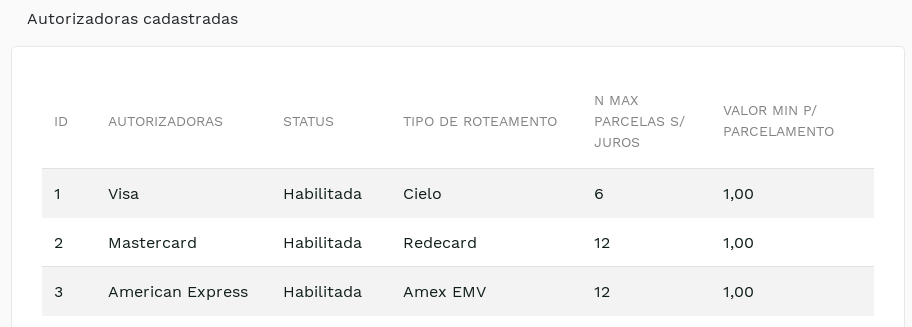
Remembering that authorizers are always associated with a Routing in Carat Portal BackOffice.
This Routing defines, for example, the acquirer responsible for routing credit transactions.
PIX
Payment
This documentation describes the integration with Pix through Carat Portal, using the CardSE via SiTef routing.
Registration information
Besides the usual information for registration on Carat Portal, for integrating with Pix, more data is necessary:
| Field | Description | Format | Mandatory |
|---|---|---|---|
psp | Payment service provider. If it isn't sent, the value registered on SiTef will be used. | < 8 N | NO |
REST Payment
Flow
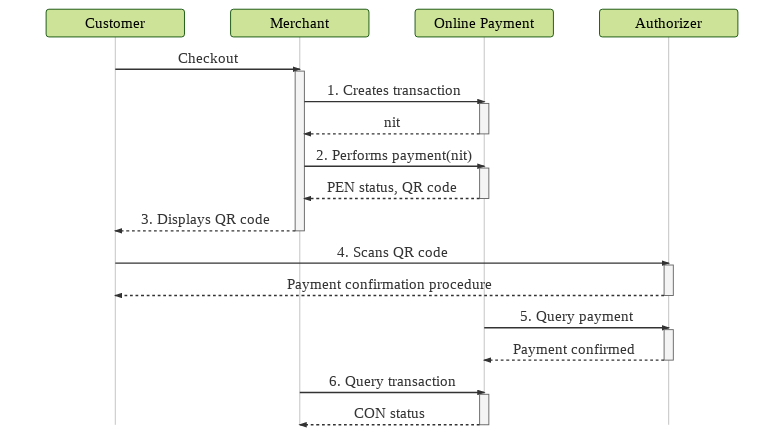
- The merchant creates the transaction on Carat Portal passing some additional Pix information and receives a NIT as a response.
- The merchant calls the payment effectuation service and receives a QR code and a transaction with
PEN(pending) status. - The merchant displays the QR code to the customer.
- The customer scans the QR code with the Pix app and goes through the payment confirmation procedures requested by the authorizer.
- While the customer finishes the payment, Carat Portal will query the sale situation on the authorizer until the transaction ends.
- The merchant, in turn, must query the transaction status on Carat Portal until it doesn't have the
PENstatus anymore.
Attention:
If the status remains pending (
PEN) after 3 (three) minutes, Carat Portal will undo the transaction alongside Pix.
Additional information when creating the transaction
For Pix transactions, the authorizer_id = 440 must be used.
Below are the additional parameters that can be sent on Pix transactions:
| Parameter | Description | Format | Mandatory | |||
|---|---|---|---|---|---|---|
| additional_data | ||||||
pix_psp | Payment service provider. If it isn't sent, the value registered on Carat Portal will be used. | < 8 AN | NO | |||
pix_question | Question from the merchant to the customer (will be displayed on the app). | < 140 AN | NO | |||
ecomm_pos_ref | This field will send an identification that will appear on the SiTef Web report for e-commerce transactions. | < 8 AN | NO | |||
| additional_data.pix_data[] | Free content list. Allows sending data to the customer's app like acquired services list, promotional information or other desired data. | |||||
key | Field identification. | < 50 AN | NO | |||
value | Field value. | < 200 AN | NO | |||
| additional_data.items[] | ||||||
ean | EAN product code. Attention: if EAN and SKU are sent simultaneously, only EAN will be considered. | < 17 AN | NO | |||
sku | SKU product code. Attention: if EAN and SKU are sent simultaneously, only EAN will be considered. | < 17 AN | NO | |||
description | Product description. | < 30 AN | NO | |||
quantity | Product quantity. | < 15 N | NO | |||
quantity_type | Quantity type:
| < 2 AN | NO | |||
unit_price | Unit price of the product in cents. | < 12 N | NO | |||
Example:
To use this example, don't forget to define the variable {{url}} with the value
curl
--request POST "https://esitef-homologacao.softwareexpress.com.br/e-sitef/api/v1/transactions"
--header "Content-Type: application/json"
--header "merchant_id: xxxxxxxx"
--header "merchant_key: xxxxxxxxxxx"
--data-binary
{
   "merchant_usn":"12042142155",
   "order_id":"12042142155",
   "installments":"1",
   "installment_type":"4",
   "authorizer_id":"440",
   "amount":"1000",
   "additional_data":{
      "pix_psp":"12345678",
      "pix_question":"Deseja receber 10% de desconto para sua proxima compra?",
      "pix_data":[
         {
            "key":"Pontos Ganhos",
            "value":"23"
         },
         {
            "key":"NumPromo",
            "value":"234523452345"
         }
      ],
      "items":[
         {
            "description":"ItemTeste",
            "quantity":"1",
            "sku":"1487337308522",
            "unit_price":"1000",
            "quantity_type":"u"
         },
         {
            "description":"ItemTeste2",
            "quantity":"3",
            "ean":"9283746529384675",
            "unit_price":"2500",
            "quantity_type":"g"
         }
      ],
      "ecomm_pos_ref":"12345678"
   }
}
--verbose
Payment effectuation request
When using Pix, it won't be necessary to send any card data.
Example:
To use this example, don't forget to define the variable {{url}} with the value
curl
--request POST "https://esitef-homologacao.softwareexpress.com.br/e-sitef/api/v1/payments/1234567890abcdefghijklmnopqrstuvwxyz1234567890abcdefghijklmnopqr"
--header "Content-Type: application/json"
--header "merchant_id: xxxxxxxx"
--header "merchant_key: xxxxxxxxxxx"
--data-binary
{}
--verbose
Payment effectuation response with non-standard size
| Parameter | Description | Format |
|---|---|---|
authorization_number | Authorization number. | < 100 AN |
host_usn | Host USN. | < 30 AN |
Additional response data on the payment effectuation
Observation:
Theses additional fields will also be shown when making subsequent queries.
| Parameter | Description | Format |
|---|---|---|
| payment | ||
pix_psp | Payment service provider. It is only returned for Pix with Long Expiration | < 8 AN |
pix_answer | Response to the pix_question. | < 140 AN |
qr_code | QR code to be displayed to the customer. | < 9999 AN |
e2eid | Id sent by PSP upon payment confirmation. | < 130 AN |
Attention:
In case of a communication failure in this operation, it will be necessary to create another transaction.
Example:
{
  "code": "0",
  "message": "OK. Transaction successful.",
  "payment": {
    "authorizer_code": "000",
    "authorizer_message": "Transacao OK",
    "status": "PEN",
    "nit": "1234567890abcdefghijklmnopqrstuvwxyz1234567890abcdefghijklmnopqr",
    "order_id": "13034649671",
    "authorizer_id": "2",
    "acquirer_id": "1271",
    "acquirer_name": "CardSE",
    "authorizer_date": "13/07/2017T15:52",
    "authorization_number": "132030",
    "merchant_usn": "13034649671",
    "esitef_usn": "170713097340300",
    "sitef_usn": "132030",
    "host_usn": "000000000",
    "payment_date": "13/07/2017T15:52",
    "amount": "1000",
    "authorizer_merchant_id": "000000000000005",
    "pix_psp": "12345678",
    "pix_answer": "No",
    "qr_code": "The quick brown fox jumps over the lazy dog",
    "e2eid": "XXXXXXXXXXXXXXXXXXXXXXXXXXXXXXXX"
  }
}
HTML Payment
There are no flow differences to the merchant.
As in the REST Payment, additional parameters on the transaction creation can be sent, using the same format.
REST Cancel
Cancel request
When using Pix, it won't be necessary to send any card data.
Example:
To use this example, don't forget to define the variable {{url}} with the value
curl
--request PUT "https://esitef-homologacao.softwareexpress.com.br/e-sitef/api/v1/cancellations/1234567890abcdefghijklmnopqrstuvwxyz1234567890abcdefghijklmnopqr"
--header "Content-Type: application/json"
--header "merchant_id: xxxxxxxxxxx"
--header "merchant_key: xxxxxxxxxxx"
--data-binary
{
   "amount":"1000"
}
--verbose
Cancel additional response parameters
| Parameter | Description | Format |
|---|---|---|
| cancellation | ||
pix_psp | Payment service provider. It is only returned for Pix with Long Expiration | < 8 AN |
Example:
{
  "code": "0",
  "message": "OK. Transaction successful.",
  "cancellation": {
    "authorizer_code": "000",
    "authorizer_message": "Transacao OK",
    "status": "CON",
    "nit": " 1234567890abcdefghijklmnopqrstuvwxyz1234567890abcdefghijklmnopqr",
    "order_id": "09062259711",
    "customer_receipt": "=== COMPROVANTE ===",
    "merchant_receipt": "=== COMPROVANTE ===",
    "authorizer_id": "2",
    "acquirer_id": "1271",
    "acquirer_name": "CardSE",
    "authorizer_date": "09/11/2017T18:23",
    "authorization_number": "092423",
    "merchant_usn": "9062259711",
    "esitef_usn": "171109108051261",
    "sitef_usn": "092424",
    "host_usn": "999092424   ",
    "amount": "1000",
    "payment_type": "O",
    "authorizer_merchant_id": "000000000000000",
    "esitef_date": "09/11/2017T18:23",
    "pix_psp": "12345678"
  }
}
Generate payment link on the Merchant's Portal
It's also possible to make Pix payments using the payment link functionality of the Merchant's Portal. However, additional Pix information cannot yet be sent.
Registering Pix keys on the Merchant's Portal
When acessing the configuration for a Pix authorizer, a button to register your Pix keys will be displayed:
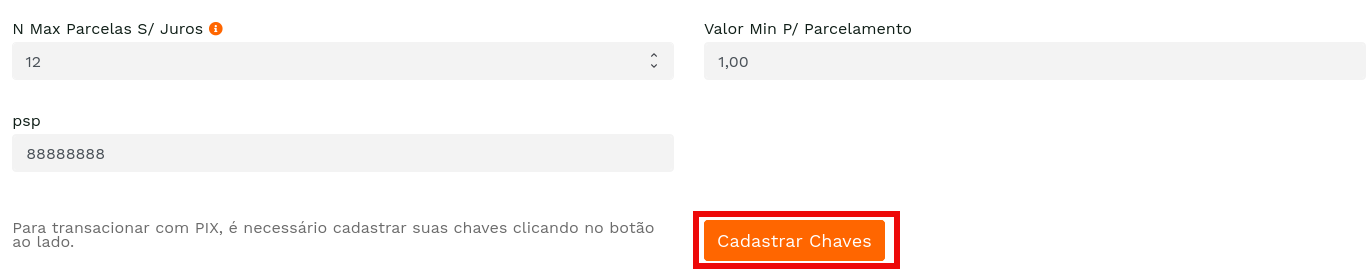
By clicking the "Cadastrar Chaves" button, the user will be redirected to a page containing information about the merchant and a PSP list:
Select the PSP you wish to use and click "Adicionar", Type your Pix key and your credential information and click "Salvar".
Some PSPs request the CNPJ with the credential that enables the transaction, include the CNPJ and click "Confirmar".
If you wish to alter credential information, click "Editar credencial".
After clicking on "Editar credencial", the fields referring to the credential will be displayed, as shown below.
If you do not want to change the credential, click "Cancelar", so the credential will not be changed.
If you want to delete them, click "Remover".
After making your desired changes, click "Salvar".
Updated about 2 months ago